


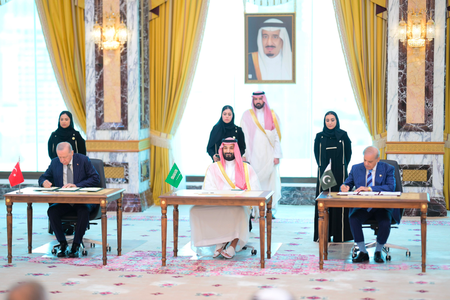
New Delhi, Sep16 (IANS) Pakistan on Wednesday condemned the attempted drone attack by Yemen’s Houthis near the holy city of Mecca in Saudi Arabia, but avoided any military commitment, despite a military pact signed with Riyadh and Ankara, touted as being similar to NATO.
Islamabad’s reaction reflects a mix of strategic caution, domestic constraints, and regional balancing, according to some reports.
Pakistan initially signed the Makkah Joint Defence Pact with Saudi Arabia in September 2025, pledging that any attack on one country will be treated as an attack on both. Subsequent reports suggested, amidst Islamabad’s attempt to present itself as a neutral mediator striving to bring peace between the United States and Iran, that the Pakistani army had sent around 8,000 soldiers and a dozen fighter jets to protect Saudi Arabia.
Turkey joined the pact last month, building upon the earlier Strategic Mutual Defence Agreement amidst the ongoing Iran war.
A Secretariat was established in Riyadh, with Pakistan slated to provide the first Secretary-General, underscoring its central role in the alliance.
The pact’s central clause, specifying that an armed attack against any one of the three partners be regarded as an attack against them all, promised Pakistani manpower and nuclear-backed deterrence for Riyadh; and for Ankara, it signalled influence in the Gulf. For Islamabad, it was a chance to reaffirm its strategic ties with Saudi Arabia and Turkey, which reportedly supplies it with defence equipment like the KORKUT against low-flying aerial threats and the SAHIN 40mm counter-drone system.
This month, days after Houthis escalated attacks on Saudi Arabia, Pakistan had given a roundabout reply to probable action in light of the pact, saying that there are no such talks being held and will act “when the time comes”.
Now, the pact is further tested with reportedly Iran-backed Houthi rebels launching drones inside Saudi territory, one of which was intercepted near Mecca. Saudi officials described the incident as an attack on Islam’s holiest city, though the Houthis denied targeting religious sites, claiming their operations were aimed at oil facilities and military bases.
Pakistan Prime Minister Shehbaz Sharif did issue a condemnation, calling the attempted strike “dastardly and heinous”, praising Saudi forces for their vigilance and reaffirming Islamabad’s solidarity with Riyadh.
Yet, Pakistan stopped short of promising military assistance. Instead, officials stressed that the pact was “defensive in nature” and not designed for offensive operations.
Pakistan’s military spokesperson Lt. Gen. Ahmed Sharif Chaudhry on Wednesday clarified that the alliance was about “collective deterrence” and had “no regional aspirations”.
This careful wording reflects Pakistan’s reluctance to be drawn into direct conflict with the Houthis, and by extension, Iran. Pakistan shares a long border with Iran and cannot afford to antagonise Tehran. Direct military involvement against Iran’s allies could destabilise its western frontier, where Islamabad is involved in a severe armed conflict with the Baloch fighters at the Pakistan-Iran-Afghanistan trijunction.
Additionally, Pakistan’s economy is broken, dependent on international financial aid, including from Saudi Arabia, and remittances from expatriates in the Gulf. Meanwhile, the Mecca Pact is said to be built on NATO’s “an attack on one is an attack on all” clause, but its operational details remain vague.
Pakistani officials have hinted that activation depends on the nature of aggression and collective decision-making, leaving room for interpretation. Since Islamabad is also mediating between Washington and Tehran, it is trying to position itself as a potential broker rather than a combatant.
A military response could undermine this role, as is being held by some observers. Saudi Arabia would expect the pact to guarantee a physical military backing, but Pakistan’s hesitation suggests that the agreement is more symbolic than operational.
Analysts argue that the pact was always more about geopolitical signalling than genuine collective security. For Riyadh, invoking Mecca’s sanctity may rally global opinion, especially from Islamic nations, but without tangible support from allies, its real deterrence value remains limited.
–IANS
jb/vd