
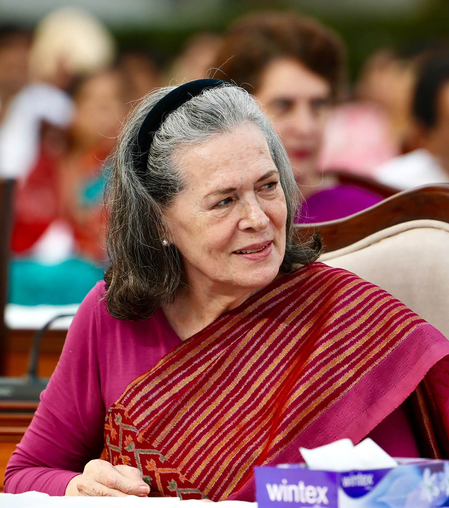
New Delhi, Nov 10 (IANS) Reflecting on the events following the Congress-led United Progressive Alliance’s (UPA) victory in the 2004 general elections, Congress Parliamentary Party (CPP) Chairperson Sonia Gandhi has recalled the emotional turmoil she experienced while deciding against taking up the post of Prime Minister, describing the conflict between her sense of duty towards the party, her personal reservations and the absence of her late husband Rajiv Gandhi’s guidance.
In an exclusive excerpt from her upcoming memoir, ‘Belonging: A Journey of Love’, shared with The Indian Express courtesy of HarperCollins India, Sonia Gandhi has recounted the days and hours leading up to her historic decision in 2004, including conversations with her children, discussions with alliance leaders and the moment she eventually named Dr Manmohan Singh as her successor.
Recalling conversations with Rahul Gandhi and Priyanka Gandhi Vadra months before the elections, Sonia Gandhi said the possibility of her becoming Prime Minister had already been discussed within the family. She said both her children were opposed to the idea because of the tragic experiences they had witnessed in their family.
“Some months before the election, my children and I had discussed the issue of my possible prime ministership. One of them asked me straight out whether I would accept the post, just in case our party pulled off a victory. ‘Absolutely not!’ I’d said, almost indignantly. ‘Are you sure?’ they pressed me. ‘I’m very clear,’ I said emphatically. Neither Rahul nor Priyanka felt that I should become prime minister. They’d lived through the trauma of their grandmother’s assassination and the brutal murder of their father. In their minds, holding that office was intrinsically linked with heightened danger,” Sonia Gandhi wrote.
She said that throughout the election campaign, whenever the question of her becoming Prime Minister was raised publicly, she chose to give a “noncommittal answer”. According to her, her immediate priority was to keep Congress united and ensure that the party faced its political opponents as a cohesive team.
“It wasn’t an option to allow a leadership struggle to arise between the contenders in our party. I kept my views firmly to myself, not even confiding in my closest colleagues. I just knew instinctively that the person to carry forward the legacy of past Congress governments would have to be someone with long experience in government and an impeccable record of integrity,” she said.
Sonia Gandhi also described the emotional dilemma she faced after the UPA’s electoral victory, saying that while one part of her firmly rejected the idea of becoming Prime Minister, another reminded her of the responsibility she owed to party workers and voters who had supported Congress.
“My emotions were changing, moment to moment. One minute I was clear, the next, I was torn,” she recalled.
She further revealed that leaders of the UPA alliance made repeated attempts to persuade her to accept the top post. Recalling one such moment when she felt “overpowered” by their insistence, Sonia Gandhi said she eventually responded with the words, “Theek hai”.
However, she said the alliance leaders immediately interpreted her response as an acceptance of the Prime Minister’s post and began congratulating her even before she could complete what she wanted to say.
Sonia Gandhi also recalled that Rahul and Priyanka were deeply unhappy when they learnt that she had appeared to agree to take up the position. She said both of them approached her with visible concern, as they had always considered themselves responsible for protecting their mother following the assassination of their father, former Prime Minister Rajiv Gandhi.
“Both of them came striding towards me with perturbed expressions on their faces: my two children who saw themselves as my protectors after the death of their father. I was already exhausted by the vehemence of the alliance leaders; now I had to face them,” she wrote.
Explaining the considerations that ultimately shaped her decision, Sonia Gandhi said she had an instinctive feeling that her actions would have consequences extending beyond the Congress and could affect the future direction of the country.
She said India needed stable and capable governance that could move the country away from divisive politics and focus on development and progress.
“An instinct kept warning me that my actions would have far-reaching consequences, not just for my party but for India. What we needed was firm and able governance to steer India away from divisive politics. More than anything else, we needed development and progress. My entry into politics had been driven by the conviction that the BJP, propelled by the RSS and its many fanatical wings, would encourage strife between communities and subvert the Constitution if they came to power,” she said.
“The BJP and its allies would, for certain use my ‘foreign origin’ as an issue; they would stir up emotions and create havoc that would subsume every other good — of the past, and of the coming years. How could I agree to holding the office of prime minister knowing it could wound my country, the country that I loved? No, never!” she wrote.
Sonia Gandhi said that after weighing the circumstances, she finally resolved not to allow herself to be persuaded into changing her decision. Recalling the subsequent meeting of Congress MPs, she said several members once again tried to “implore” her to accept the Prime Minister’s post.
“Throughout these past six years that I have been in politics, one thing has been clear to me. And that is, as I have often stated, that the post of prime minister is not my aim. I was always certain that if ever I found myself in the position that I am in today, I would follow my own inner voice. Today, that voice tells me I must humbly decline this post,” she said.
“‘No, no, no!’ they shout, some gesticulating wildly,” she writes in the excerpt.
She continued, acknowledging that the party had unanimously chosen her as its leader and that the faith reposed in her had placed her under considerable pressure to reconsider her stand. However, she said she had to remain committed to the principles that had guided her political journey.
“Power in itself has never attracted me, nor has position been my goal. My aim has always been to defend the secular foundation of our nation and the poor of our country — the creed sacred to Indiraji and Rajivji,” she said.
“We have moved forward a significant step towards this goal. We have waged a successful battle. But we have not won the war. That is a long and arduous struggle, and I will continue it with full determination… But I appeal to you to understand the force of my conviction. I request you to accept my decision and to recognise that I will not reverse it,” she further writes in the excerpt shared by The Indian Express.
“Our foremost responsibility at this critical time is to provide India with a secular government that is strong and stable. Friends, you have given me your generous support; you have struggled against all odds with me. As one of you and as president of the Congress Party, I pledge myself to work with you and for the country. My resolve will in fact be all the more firm, to fight for our principles, for our vision, and for our ideals,” she added.
She recalled that while some MPs continued to raise objections and protest against her decision, the gathering gradually became calmer as she explained her position.
She then sought the members’ approval to nominate her successor and announced the name of Dr Manmohan Singh as the leader of the Congress Parliamentary Party.
Sonia Gandhi said that once she named Singh, the room erupted in applause, with several MPs standing up, raising slogans and becoming emotional. She also noticed that Rahul and Priyanka had stood up and were applauding her decision.
–IANS
sd/dpb