


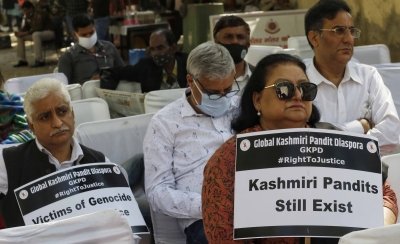
Washington, May 18 (IANS) For 36 years, Kashmir existed for Sheerin Raina in fragments — stories told at the dinner table in New Jersey, fading photographs, temple names spoken with reverence, and memories inherited from parents who had left in the middle of the night and never truly returned.
Now, at 21, she is preparing to go there for the first time.
In an exclusive webinar interaction with IANS, Kashmiri Pandit community leaders, activists and second-generation youth across the United States described their planned June visit to Kashmir as both a pilgrimage and an act of cultural survival.
“I have been asking my dad since probably I was in seventh grade, you know, when can we go back to Kashmir?” Raina said.
“I didn’t realise at the time that it’s such a loaded and deep question.”
In June, dozens of Kashmiri Pandits from across the world plan to travel together to the Valley in what organisers describe as a “heritage tour” and “international conclave” — an attempt not merely to revisit a place, but to reconnect a scattered community with a homeland many fear is slipping into memory.
For the older generation, the journey carries the weight of exile. For the younger one, it is an attempt to understand who they are.
“This is our seventh exodus from Kashmir,” said Rakesh Kaul, an author and community leader based in New Jersey.
“But in this most recent genocide and ethnic cleansing, this is the first time that we are formally going back in as large a number.”
Kaul described the return not simply as a visit, but as an inheritance being passed to a younger generation raised far from the Valley.
“What we are doing… is we are giving a gift to our children who will be there,” he said.
“The Kashmir that you have heard of from your grandparents, stories of pain… that Kashmir also has something very profound that is your living inheritance.”
The tour, scheduled from June 6 to 14, will include visits to temples, heritage sites and ancestral places across Kashmir, followed by an international conclave themed: “From Exile to Excellence: The Kashmiri Pandit Journey of Resilience, Renaissance and Return.”
Dr. Surinder Kaul, a Houston-based physician and co-founder of Global Kashmiri Pandit Diaspora (GKPD), described the effort as both emotional and urgent.
“The biggest threat of our community is looming extinction,” he said.
“We are not connected to our roots, and it’s very important for our people to remain connected, for our kids, for our youth.”
Kaul said nearly 90 per cent of the community had not been able to return to Kashmir since the militancy-driven exodus of 1989-90.
“We are not going there as victims,” he said.
“We are going there as a resilient community.”
Across the diaspora, organisers say the effort has become a collective attempt to preserve memory before it fades with time.
Nirja Kaul Sadhu, the New Jersey-based international coordinator of GKPD, has been among those helping drive the initiative, working alongside community organisers across countries to bring families, youth and survivors of the exodus into a shared effort centred on cultural continuity.
Many participants spoke less about politics and more about inheritance — what happens when an entire generation grows up knowing its homeland only through grief-filled recollections.
“My connection to Kashmir now is mostly in my childhood memories,” said Amit Raina, an IT professional from Houston who left Kashmir as a child.
“Memories of my home, memories of our temples, memories that are slowly fading away.”
Still, he said, the community could not afford to remain paralysed by fear.
“We wanna go back to our homeland not as tourists, not as strangers, but as rightful sons and daughters of the soil,” he added.
For some, the return is deeply personal.
“It is going back to see your mom,” said Sunita Ticku Bhan, a Houston-based coordinator with GKPD US.
“You are away from your mother, and you are going to hug her and kiss her and tell her, ‘Mom, I missed you for so many years.'”
Joining the discussion, Rommel Bhan, reflected on the emotional pull of returning to a land many still describe as spiritually inseparable from their identity.
Participants repeatedly said the journey was as much for their children as for themselves.
Vinod Raina, a New Jersey-based IT professional associated with the Kashmiri Overseas Association, spoke about wanting younger generations to see ancestral temples and heritage sites firsthand rather than only hearing stories about them at home.
“Our children deserve to know where their roots are,” said Uphaar Kotru, President of the Kashmiri Overseas Association in California.
“Kashmir is not just a story that I’ve been telling my kids. It’s a place that they know.”
Mohan Wanchoo, an entrepreneur and GKPD US coordinator based in New York, said the initiative was also about rebuilding bonds within a dispersed community that had spent decades rebuilding lives across continents while trying to retain links to Kashmir’s cultural and spiritual traditions.
For younger members like Sheerin Raina, the Valley exists as both paradise and wound.
“It’s known as paradise on Earth,” she said.
“But there’s also a lot of darkness within there as well.”
Still, she said, the stories must continue.
“Only we can control our story from here on out,” she said.
“No one else will do it for us.”
The exodus of Kashmiri Pandits from the Valley in 1989 and 1990 remains one of the most painful and politically contested chapters in modern Indian history.
Tens of thousands of Kashmiri Hindus fled their homes amid rising militancy, killings and threats, eventually dispersing across India and the world.
In recent years, renewed public discussion around the community’s displacement — amplified by activism, documentaries and films such as The Kashmir Files — has brought greater visibility to their experiences.
Yet for many displaced families, the central question remains unresolved: whether return is still possible, and what “home” means after nearly four decades away.
–IANS
int/lkj/khz