


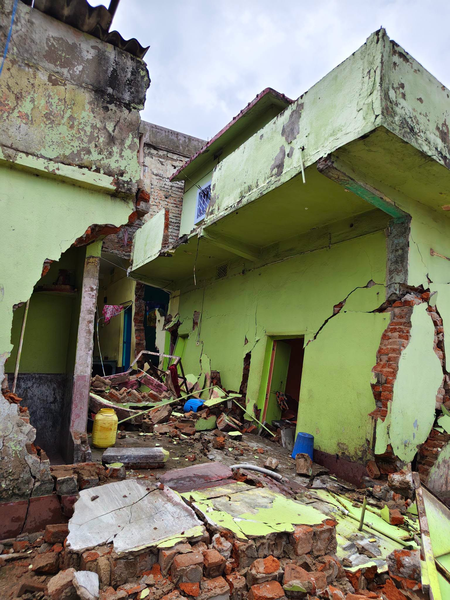
Dhanbad, Sep 7 (IANS) Imagine a family asleep inside their home when a loud explosion erupts from beneath the ground. Within moments, cracks appear in the walls, the floor shifts, and part of the house disappears into a deep cavity. Outside, toxic gases rise from the ground, flames emerge through fissures, and smoke billows from the earth.
For residents of Dhanbad’s coal belt, such scenes are no longer rare. Life in the region is increasingly being overshadowed by fear as frequent land subsidence, underground fires, and the formation of sinkholes continue to threaten lives and property.
A major reason behind the crisis is the century-old underground coal fire raging beneath large parts of the coalfield. Since January this year, more than 45 incidents of land subsidence and sinkhole formation have been reported across the coal belt.
The frequency of such incidents has increased during August and September with the onset of monsoon rains.
Developments over the past 10 days illustrate the gravity of the situation. On August 31, part of a house in Lilori Pathra collapsed into a sinkhole after the ground caved in.
On September 1, authorities began filling a deep cavity in Godhar No 6, while incidents of sinkhole formation and gas leakage were reported from Kailudih in the Katras area.
On September 3, the ground cracked open in Barari No 6 following a powerful explosion, releasing flames and toxic smoke through the fissures.
A day later, two large sinkholes appeared in Kurmi Dih, triggering panic among residents amid reports of gas leakage.
Despite repeated assurances and mitigation efforts by the Centre, the state government, coal companies and regulatory agencies, incidents linked to underground fires, subsidence, and sinkhole formation continue to escalate.
Amid growing concerns, Prime Minister’s adviser Tarun Kapoor visited the Dhanbad coalfield on August 31 and September 1. During his two-day tour, he reviewed BCCL’s mining operations, assessed the status of underground fires in Jharia and examined rehabilitation efforts.
Kapoor also interacted with resettled families and directed officials to prioritise safe and dignified rehabilitation of affected residents.
Residents of Jharia, Katras, Lodna, Kenduadih, and Baghmara continue to live with the fear of not knowing where the ground might crack next.
A series of recent incidents has posed a major safety challenge for both the administration and mining authorities.
The most alarming incident this year occurred on August 6 in Chhatabad, Katras, where land subsidence affected more than 20 houses and left several people injured.
Deep cracks appeared in numerous homes. Local residents blamed intensive blasting activities in the mining area for the disaster.
Following the incident, authorities tightened safety measures. On August 14, the Dhanbad Deputy Commissioner ordered suspension of blasting and mining activities in the affected zone until scientific studies and safety assessments were completed. Subsequently, the Directorate General of Mines Safety (DGMS) withdrew permission for controlled deep-hole blasting at New Akashkinari Colliery.
However, Chhatabad is not an isolated case. Similar incidents involving land subsidence, sinkholes and gas leaks have continued to emerge from Lodna, Barari, Kenduadih, and other parts of Katras. The recurring events have intensified concerns over whether the existing safety and rehabilitation framework is adequate to address the growing threat.
Experts say the problem is not merely a result of monsoon rains or isolated incidents. Decades of underground mining, abandoned mine workings, persistent underground fires and extensive voids beneath the surface have rendered the region highly vulnerable.
During the monsoon, rainwater seeps into these weakened zones, further eroding the stability of the overlying soil. In many areas, vibrations generated by heavy blasting are believed to have aggravated the risk.
While ground collapses continue to endanger lives, questions are also being raised about the pace of the long-running rehabilitation programme.
Ensuring the safety of residents and relocating vulnerable families in time remains the biggest challenge. For families whose homes have already developed cracks, every spell of rain and every loud explosion signals a potential disaster.
According to BCCL Director, Technical and Operations, Sanjay Kumar Singh, providing immediate safe housing to families affected by subsidence and gas leakage in areas such as Kenduadih and Lodna remains a priority.
He said that under the revised Jharia Master Plan, rehabilitation and livelihood arrangements for displaced residents are being accelerated in Belgaria and Karmatand townships in coordination with the JRDA, with an allocation of Rs 5,940 crore.
For Dhanbad’s coal belt, the question is no longer when the next sinkhole will appear. The real concern is who will be caught in its path when the ground gives way again.
–IANS
snc/skp/vd