


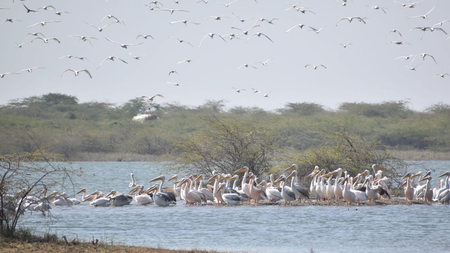
Gandhinagar, May 8 (IANS) Gujarat has recorded the arrival of more than 35 lakh migratory and local birds over the past year across its wetlands and protected water bodies, including five Ramsar sites, according to figures released by the state Forest department for 2025–26 on Friday.
Officials said the data reflects seasonal movement patterns along the Central Asian flyway, with peak arrivals between November and February.
The highest concentration was recorded at Nadabet in the Vav–Tharad border region, where a January 2026 census counted nearly 14.90 lakh birds belonging to 183 species.
The survey reported large populations of lesser flamingos exceeding nine lakh, more than 1.63 lakh black-winged stilts, around 1.2 lakh greater flamingos and more than one lakh great white pelicans.
Significant numbers of Eurasian coot, sandpipers, cormorants, gulls, spoonbills and cranes were also documented.
In Kutch, the “Road to Heaven” wetland near Dholavira recorded more than 7.9 lakh birds during the year, including flamingos, pelicans, gulls, stilts, painted storks and cranes.
The Forest department attributed fluctuations in bird numbers in this desert-adjacent habitat to rainfall variations influencing wetland conditions.
Nal Sarovar Bird Sanctuary in Ahmedabad district reported more than 6.42 lakh migratory birds across 270 species.
Observed species included pintails, teals, godwits, geese, pelicans, flamingos, cranes, spoonbills, egrets and other waterfowl.
The wetland, covering about 120 square km, was declared a bird sanctuary in 1969 and designated a Ramsar site in 2012.
Thol Wildlife Sanctuary, also a Ramsar site since 2021, recorded 74,452 migratory birds from 205 species in 2026.
Officials noted that managed water availability in the sanctuary supports bird populations during extreme summer temperatures, while the site continues to function as a seasonal winter habitat.
Khijadiya Bird Sanctuary in Jamnagar recorded the highest biodiversity among surveyed sites, with 347 bird species and more than 3.12 lakh migratory birds in 2025–26.
Around 190 species were identified as migratory, arriving from regions including Siberia, Central Asia, Europe, West Asia, and parts of Africa and South America.
Species recorded include pelicans, cranes, storks, flamingos, ducks, egrets and various waders. The sanctuary was designated a Ramsar site in 2021.
Vadhwana Wetland recorded 47,793 migratory birds belonging to 159 species, including northern pintail, common teal, ruddy shelduck, spoonbills, herons, cormorants, godwits, storks and starlings.
Officials added that the wetland continues to serve as a seasonal stopover site for waterfowl migrating across western India.
Chhari Dhandh in Kutch, declared Gujarat’s fifth Ramsar site in 2026, spans around 22,700 hectares and recorded more than 1.50 lakh birds from over 280 species.
The wetland attracts long-distance migratory species travelling thousands of kilometres, including cranes from Central Asian regions.
According to the forest department, Gujarat’s wetlands form part of a major migratory corridor and are primarily active during the winter migration period.
Conservation measures, habitat management and water provisioning are carried out across key sites to support avian populations throughout the year.
World Migratory Bird Day is observed globally on May 9.
The 2026 theme, as cited by conservation programmes, is “Every Bird Matters, Our Observation is Important”, focusing on monitoring and protection of migratory species.
Gujarat currently has five Ramsar-designated wetlands: Nal Sarovar Bird Sanctuary, Thol Wildlife Sanctuary, Khijadiya Wildlife Sanctuary, Vadhwana Wetland and Chhari Dhandh in Kutch, all of which form part of the state’s monitored wetland network supporting seasonal bird migration.
–IANS
mys/khz