


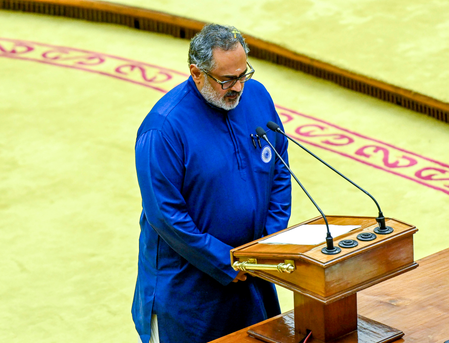
Thiruvananthapuram, Aug 28 (IANS) Kerala BJP president, Rajeev Chandrasekhar, on Friday accused the Chief Minister V.D. Satheesan government of double standards in dealing with controversial remarks against religious beliefs.
He alleged that it had remained silent on statements targeting Hindu faith while taking action in other cases.
Questioning the government’s response to remarks attributed to Sunny M. Kapikad and others, Chandrasekhar demanded immediate legal action, arguing that freedom of expression could not be invoked to justify statements that hurt religious sentiments.
“Why are Chief Minister V.D. Satheesan, Home Minister Ramesh Chennithala and Devaswom Minister K. Muraleedharan maintaining silence over hate speeches against Hindu beliefs? Is the law not equally applicable to everyone?” he asked.
Chandrasekhar’s remarks came as the new government completed 100 days in office.
He alleged that the administration had failed to deliver on development, employment and other promises, describing the period as “100 days of APPAKADAM Politics”.
He also sought to put the government on the defensive over Sabarimala, alleging that the Congress had raised issues including the alleged theft of gold from the temple while in Opposition but had forgotten Sabarimala and Lord Ayyappa after coming to power.
“The politics of appeasement and double standards is all that we have seen in these 100 days. Instead of taking measures that benefit ordinary people, the government is encouraging a politics of divide and rule,” Chandrasekhar alleged.
The BJP leader claimed that the government had betrayed thousands of Hindu voters who had placed their trust in it and urged the government to take strong legal action against those making what he termed as derogatory remarks against religious beliefs.
His remarks are likely to add a religious dimension to the BJP’s broader political offensive against the government as it completes its first 100 days.
The demand for action against Kapikad also comes amid renewed political debate over the limits of free speech and the state’s responsibility to respond uniformly to contentious statements concerning different faiths.
–IANS
sg/rad