
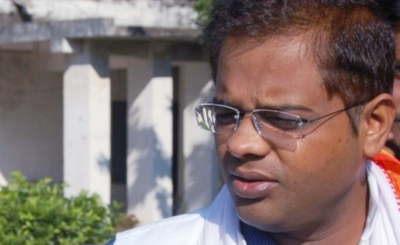
Raipur, Nov 5 (IANS) Janta Congress Chhattisgarh (J) President, Amit Jogi, has strongly objected to a police notice served at his residence in connection with an FIR registered over a satirical video featuring masked representations of Prime Minister Narendra Modi and Chief Election Commissioner Gyanesh Kumar.
In a detailed statement and video message released on social media, Amit Jogi rejected suggestions that he was evading authorities and questioned the manner in which the notice was delivered.
The controversy revolves around a video produced by Jogi that depicts individuals wearing masks resembling the Prime Minister and the Chief Election Commissioner in a symbolic wedding and honeymoon sequence.
According to Jogi, the video was intended as political satire aimed at raising concerns about the electoral process and alleged manipulation of votes.
However, complaints lodged by BJP Raipur district president Ramesh Singh Thakur and former minister and BJP MLA Rajesh Munat led to the registration of an FIR at the Civil Lines police station.
The case has been registered under Sections 196, 352, 353(2), and 356(2) of the Bharatiya Nyaya Sanhita (BNS), along with Section 67 of the Information Technology Act.
Police subsequently issued Notice No. 569/2026, dated November 4, and affixed it at Jogi’s residence after serving copies to his wife and mother.
Jogi argued that the police were fully aware he was neither at home nor in Chhattisgarh when the notice was served.
He said that his office had informed the Director General of Police and the Inspector General of Police, Raipur Range, on October 30 about his pre-scheduled trip to Gujarat between November 2 and November 8.
According to Jogi, the visit was undertaken at the invitation of friends, and he is currently receiving security protection from the Gujarat Police during the programme.
Describing the action as politically motivated, Jogi alleged that the notice and FIR were intended to harass not only him but also his family. He pointed out that both complainants were prominent BJP leaders while the BJP was also the ruling party in Chhattisgarh.
In his view, the case reflects political persecution of the Opposition rather than a legitimate legal complaint. Despite his objections, Jogi said he would fully cooperate with the investigation and appear before the authorities after returning to the state.
“I have faith in the judiciary,” he said, while questioning how a satirical video involving masked political caricatures could be treated as a communal offence.
He further asked what religious or caste element the authorities had identified in the content and suggested that the case represented a disproportionate reaction to political satire.
Addressing the legal provisions invoked against him, Jogi maintained that none of the cited offences were applicable.
On Section 196 BNS, which deals with promoting enmity between groups, he argued that the video neither mentioned nor targeted any religion, caste, or community.
Regarding Section 352 BNS, related to intentional insult aimed at provoking a breach of peace, he contended that political satire is protected under the constitutional guarantee of free speech and is directed at public conduct rather than individuals.
On Section 353(2) BNS, concerning statements that may cause public mischief, Jogi said the content was clearly presented as satire and comedy and could not reasonably be interpreted as a factual assertion.
Referring to Section 356(2) BNS on defamation, he claimed that the video contained no factual allegations, only political commentary expressed through caricature and symbolic representation.
Responding to the charge under Section 67 of the Information Technology Act, Jogi said the video contained no nudity, sexual activity, or explicit obscenity, adding that the use of a honeymoon setting for satirical purposes could not be considered obscene under law.
Jogi described the criminalisation of political satire as an attack on democratic values and the right to dissent.
Drawing parallels with traditions of satire dating back to ancient Greece and the “vidushaka” tradition in Bharata Muni’s Natya Shastra, he said political humour has long been a legitimate form of public commentary.
He added that the video was an attempt to communicate contemporary political concerns in a language that resonates with younger generations.
The JCC(J) leader also reiterated his party’s longstanding concerns regarding the electoral process. He noted that the JCC(J), which he described as the state’s only recognised regional political party, has not contested elections since 2024 because of its reservations about the electoral system.
Amit Jogi is the son of late Chhattisgarh Chief Minister Ajit Jogi and currently serves as President of the JCC(J).
–IANS
sktr/rad