


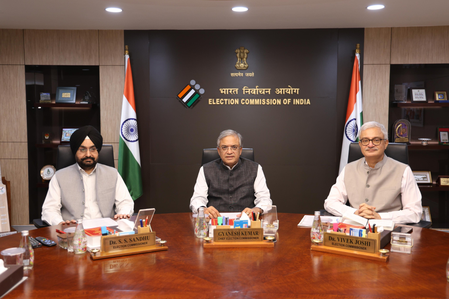
New Delhi, Oct 5 (IANS) Amid the ongoing protests, Election Commission of India (ECI) sources on Monday dismissed claims that the panel had pulled down the September 26 press note, through which it modified certain terms related to Form 6 for SIR and tasked BLOs to collect notice-related additional documents from voters’ homes, from its website.
Apart from extending the SIR deadlines in Delhi and Maharashtra, the ECI, in its note issued last month, had countered allegations of friction within the Commission and revised the SIR notice-related procedure.
“This Press Note is issued as per the decisions of the meeting of the Commission held on September 26, 2026 and has the approval of the full Commission,” the ECI had said.
On Monday, an ECI source said: “The September 26 press note is available on the ECI website. Was never taken down.”
Earlier in the day, the Supreme Court issued a notice to the Centre and the ECI on a plea challenging the manner in which the powers of the poll panel were being exercised.
The apex court was hearing a petition which raised the question of whether CEC Gyanesh Kumar was empowered to individually exercise or represent powers vested in the multi-member poll body.
A Bench of Chief Justice of India (CJI) Surya Kant and Justices Joymalya Bagchi and V. Mohana also sought responses from the three Election Commissioners after senior advocate Vikas Singh, appearing for the petitioner, submitted that the credibility of the ECI had been undermined and that the CEC was acting contrary to the statutory framework governing the poll body.
The CJI-led Bench said that the top court would first require authenticated information on the allegations, stating that it could annul any decision if it is subsequently found to be unlawful.
“Let’s first have authenticated information on that (the allegations). We can always annul any decision,” the Supreme Court said.
Vikas Singh alternatively urged the apex court to direct that, until the next date of hearing, decisions of the ECI should be taken only unanimously.
However, the bench said that the Commissioners were expected to take unanimous decisions and, in the absence of unanimity, the matter was required to be decided by majority.
–IANS
rch/vd