


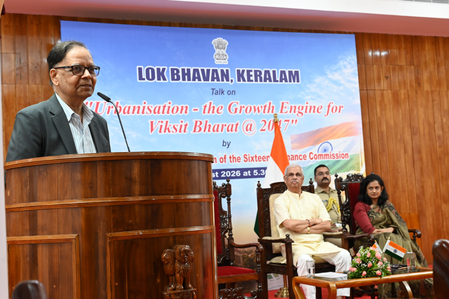
Thiruvananthapuram, Aug 12 (IANS) Urbanisation will be a critical driver of India’s economic transformation and its aspiration to become a developed nation by 2047, Arvind Panagariya, Chairman of the 16th Finance Commission, said on Wednesday.
Addressing the sixth edition of the Lok Bhavan Conversations organised by the Raj Bhavan on the theme ‘Urban Areas as Growth Engine for Viksit Bharat 2047’, Panagariya said India’s ambition to emerge as a developed and globally competitive $30-trillion economy cannot be realised without productive, resilient and efficiently governed cities.
He pointed out that virtually every developed country has high levels of urbanisation. India, too, has a long history of urban development and should not be apologetic about pursuing urbanization, he said.
Dr Panagariya said the focus of urbanisation should go beyond improving living conditions for existing urban populations. Cities must become business and job-friendly to attract people from rural areas and generate employment.
“Economic activity drives urbanisation,” he said, stressing that employment generation would also help transform rural settlements and peripheral areas of major cities and towns into vibrant urban spaces. The scarcity and high cost of urban land are among the biggest constraints on economic activity in Indian cities, Dr Panagariya said.
Acquiring large parcels of land for industrial and business activities remains extremely difficult because land holdings are highly fragmented and definitive land titles are often unavailable.
He cited the example of the Singur project in West Bengal, where thousands of individual land parcels had to be acquired, in contrast to large projects in countries such as the United States where land ownership is less fragmented.
He called for reforms to make land more readily available for productive economic activity and to reduce bottlenecks in land acquisition and urban development.
The Finance Commission Chairman also underlined the need for stronger municipal administration and better coordination among agencies responsible for urban development.
Cities need governance systems capable of supporting economic activity, infrastructure development and job creation, he said. Urban planning and land-use policies should foster entrepreneurship while improving citizens’ living conditions.
Speaking on the occasion, Governor Rajendra Arlekar said urbanisation should not be equated with Westernisation. “Urbanisation should be initiated through our roots,” the Governor said, emphasising that India’s urban development must evolve from its own culture, traditions and thought processes rather than simply importing Western models.
He said urbanisation would make an important contribution to the economic development of the country and the realisation of the Viksit Bharat vision.
–IANS
sg/skp