


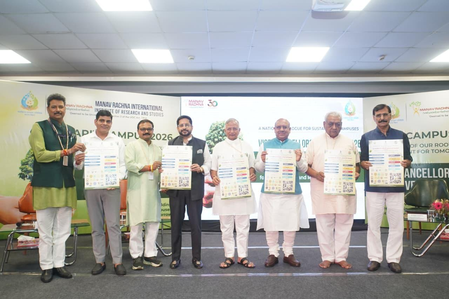
Faridabad, Aug 22 (IANS) Delhi Assembly Speaker Vijender Gupta said on Saturday that good laws require good facts, credible research and ground-level evidence, and universities must become active partners in providing that knowledge to legislatures and governments.
Addressing the inaugural ceremony of the Vice Chancellors’ Conclave 2026 at an International Institute of Research and Studies, Faridabad, Gupta said legislatures make laws, approve budgets and hold governments accountable, while universities can strengthen this process through research-based inputs, expert opinion on environmental legislation and greater student engagement with democratic institutions.
The two-day Conclave (August 22-23), themed “Green Campus: Empowering Higher Educational Institutions for a Sustainable and Resilient Future,” was attended by Dr Prashant Bhalla, President, of the host group of educational institutions; Dr H.D. Charan; members of Paryavaran Sanrakshan Gatividhi; Chancellors, Vice Chancellors and Directors from universities across the country; representatives of IITs, IIMs, NITs and IIITs; faculty members and students.
Congratulating the host educational group on completing 30 years, Gupta said its motto, “Creating Better Humans,” assumed even greater significance when linked to the responsibility of creating a better planet.
“Better human beings and a better Earth cannot be separate goals,” he said.
Describing climate change as a present reality, Gupta referred to record heat, winter smog, polluted air, sudden flooding and falling groundwater levels across Delhi and the National Capital Region.
He said the condition of the Yamuna, air quality and groundwater depletion were not merely environmental concerns, but questions of public health, the economy and the rights of future generations.
Laws and policies were necessary, he said, but sustainability also had to become a matter of values, habits and lifestyle. “If India’s universities are not green, how can India’s future be green?” he asked.
Speaker Gupta identified three roles for universities in India’s green transition: as models, as educators and as centres of research and solutions.
Describing campuses as “small cities” with their own systems of electricity, water, transport, food, buildings and waste, he said they could demonstrate solar power, rainwater harvesting, water conservation, 100 per cent waste management, waste segregation and green infrastructure at scale.
“Your campuses are our laboratories,” Gupta said, adding that successful models can give policymakers the confidence to replicate them at State and national levels.
He said students who spend four or five years practising such habits carry them into their workplaces, the villages or cities where they settle and the families they build, allowing one campus to influence an entire generation.
–IANS
rch/uk