


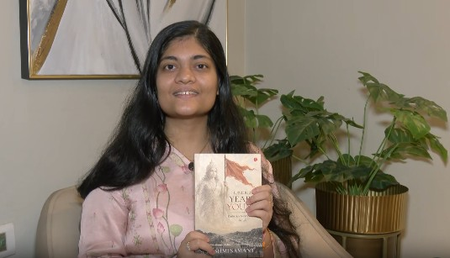
New Delhi, Oct 18 (IANS) The Rashtriya Swayamsevak Sangh (RSS) is essentially a service-oriented organisation where service itself is the highest duty.
There are many misconceptions about the RSS, and it is almost entirely viewed through a political lens.
Those who have worked with the organisation or come into contact with it have had a very positive experience. These observations were made by Rashmi Samant, author of “Hundred Years Young: Rashtriya Swayamsevak Sangh”, in a special conversation with IANS.
In the interview, Samant said that India’s real youth—the true Gen Z—are actively engaged in creative work. They are involved in nation-building, positive initiatives and impactful efforts.
“For instance, Skyroot has launched India’s first privately built space vehicle.”
Here are some excerpts from the conversation
IANS: Through the book “Hundred Years Young: Rashtriya Swayamsevak Sangh”, what picture of the RSS did you want to present that is often missing from mainstream political debates?
Rashmi Samant: The Rashtriya Swayamsevak Sangh is often viewed from a particular perspective—or, as one would say in English, through a “coloured lens”. But those who have worked with the organisation or come into contact with it have had a very positive experience. My approach was to bring forward people who have worked with the organisation and observed it closely. These are not individuals who have been associated with the RSS since childhood; rather, they joined later, saw how the Sangh functions and how it views things, and then their thinking changed. If you read these essays, you will find that they too initially held a certain perception, just like others. But once they started working with the RSS and came into contact with it, their perspective completely changed. So, this is the story of the transformation of 20 young and talented individuals who have achieved success in different walks of life.
IANS: What does the title of the book mean? In your view, how can a century-old organisation remain relevant for today’s younger generation?
Rashmi Samant: If you visit any shakha of the Sangh, you will see young people actively involved in sports, physical activities and intellectual discussions. Even today, the Rashtriya Swayamsevak Sangh remains an organisation of the youth. That is why the book is titled “100 Years Young”—because all the contributing authors are aged under 40 years. In fact, most of them are under 30 years, and only a few are above 30 years.
IANS: What were the criteria for selecting the 18 young achievers, and who are the people included whose views or experiences regarding the RSS are different?
Rashmi Samant: The authors who have written for this book have looked at it from an ordinary perspective and explained how these ideas appear in their everyday lives. It is a very unique and excellent work that shows how these concepts are lived in real life. My aim was to include people from all religions, all identities and different nationalities. Therefore, in this book you will find not only Indians but also British, Israeli and American contributors. Apart from Hindus, you will also find Christian, Muslim and Jewish perspectives. Members of the LGBTQIA+ community and their supporters are also included. The effort was to bring together people of different identities and backgrounds so that one can view the RSS from every perspective, rather than through a particular prejudiced lens.
IANS: The book discusses the concepts of Hindutva, religion and nation. How do you connect these ideas with India’s constitutional values, religious diversity and equal citizenship?
Rashmi Samant: The authors of this book look at it in a simple manner—how these facts appear in everyday life. I would call it a wonderful and unique piece of writing in which one sees how all these concepts are lived.
IANS: There are varying perceptions about the RSS. Is the purpose of this book to change those perceptions or to offer readers a perspective to understand the organisation?
Rashmi Samant: In the foreword of the book, RSS Chief Mohan Bhagwat writes that many people have written highly critical or negative things about the Sangh without knowing it properly, while some others have praised it excessively. In this book, however, you will find a middle path, where people speak on the basis of their experiences and their changed perceptions. It is not about viewing things through the lens of a particular ideology or perspective; it is simply about experiencing the RSS and its activities and writing about them.
IANS: The book emphasises service and nation-building. In your view, what concrete outcomes and parameters should one look at while evaluating the social work of the RSS?
Rashmi Samant: If you look at the work of the RSS, you will notice that over the past 100 years—whether it was an earthquake, a flood or a crisis like the Covid pandemic—their contribution has been clearly visible every time. If you look at the cover of this book, it shows the 1963 Republic Day parade in which 3,500 Swayamsevaks marched. Many people do not know that during the 1962 war with China, when the civil police were deployed on the border, it was the RSS swayamsevaks who handled civil administration work such as traffic management across India. No one knows about this. But it is historical, and there is photographic evidence of it. There is also proof that former Prime Minister late Jawaharlal Nehru invited the Sangh to participate in the Republic Day parade. There are many such things that people are not aware of. The RSS is viewed on the basis of narratives. I believe one should know the reality, look at the evidence, and then form an opinion. We should move away from slogans and sayings and look at history. That is what this book does. It does not say that the Sangh is very good; it simply states what the Sangh has done—what it did during Covid, and how it helped Sindhi Hindus who came from Pakistan during Partition when they were being mistreated.
IANS: The book includes voices from different religious and social backgrounds. How have these diverse experiences changed your own understanding of the RSS and Indian society?
Rashmi Samant: There has been a major change. The scope of the Sangh’s work is so vast that I feel one lifetime is not enough to fully understand its depth. Over the past 100 years, it has left its mark in every field—be it education, relief work, preservation of culture, work with tribal communities, or promotion of social harmony. Today, many prominent organisations are inspired by the Sangh. My perception is continuously evolving. Every day I feel that the organisation has done this as well.
IANS: Today’s youth face issues such as unemployment, examination-related controversies and political discontent. Do you feel that social organisations should work as actively on these issues as they do on cultural and ideological ones?
Rashmi Samant: The world’s largest student organisation, the Akhil Bharatiya Vidyarthi Parishad (ABVP), is inspired by the Sangh. Since 1947, it has strongly opposed issues such as paper leaks and has led movements to secure justice for students. Moreover, during Covid-19, when sex workers and members of the transgender community were left without income or social security, the RSS was among the first to step forward and provide them relief. At the time of the Gujarat earthquake, RSS swayamsevaks reached the spot even before government help arrived. The RSS works on the principle that the time spent talking about one’s work can instead be used to complete two more tasks.
IANS: In the context of protests by youth political groups such as the Cockroach Janta Party (CJP) and the activism of the Opposition, do you feel that today’s younger generation wants concrete accountability from organisations rather than ideology?
Rashmi Samant: The protests organised by the Cockroach Janta Party have seen the participation of around 3,000 to 4,000, or perhaps 10,000 youth. India’s youth population is between 30 and 40 crore. I myself am 27-years-old, which is where Gen Z begins. Those leading these protests are not actually Gen Z. They are either above 30 or 29-years-old, so technically they do not fall into the Gen Z category. I am Gen Z, and I believe that India’s real youth—the true Gen Z—are actively engaged in creative work. They are involved in nation-building, positive initiatives and impactful efforts. For example, Skyroot has launched India’s first privately built space vehicle. India’s youth are engaged in such work. Unfortunately, negative news receives far more coverage, attention and views because the algorithms of social media platforms like Instagram further amplify an atmosphere of anger and outrage. It is unfortunate that instead of the positive work being done by young Indians and young swayamsevaks to prepare the country for the next 100 or 1,000 years, such discussions receive greater attention.
IANS: Based on your experiences abroad, which aspects of the discussions about India and the RSS at the international level need to be explained in greater depth?
Rashmi Samant: I feel that everyone should understand the spirit of ‘seva’ (service) and selfless service that lies at the core of the Sangh. The RSS is often viewed through a political lens, but in reality it is a service-oriented organisation where service is the highest duty. Without understanding this, no one can truly comprehend the Rashtriya Swayamsevak Sangh. This book does not contain only my perspective; international academics associated with Indian studies have written about the RSS on the basis of their research, including British, Israeli and German scholars, as well as a German parliamentarian. Their views help in better understanding the organisation’s true vision. Based on my experience of studying and working abroad, I believe there are many misconceptions about the RSS, and it is almost entirely viewed through a political lens. This is because the Bharatiya Janata Party (BJP), a party inspired by the Sangh, is currently in power. However, the RSS has existed long before that, and its roots have always been in service.
IANS: While the RSS is celebrating its centenary year, political organisations like the CJP are questioning the system through protests. What, in your view, is the biggest reason for the ideological conflict among youth in today’s India?
Rashmi Samant: As a young Indian who has been observing the CJP protests for some time, I have read several statements by their leadership. One statement that caught my attention was “Let a hundred Jantar Mantars bloom”. This is a variation of Mao Zedong’s slogan in China, “Let a hundred flowers bloom.” That movement was followed by the Cultural Revolution and the Great Leap Forward, in which millions of people lost their lives. I believe that ideologies which seek to spread anarchy today while promising a better tomorrow are fundamentally undemocratic. We have seen similar undemocratic changes and coups in Bangladesh, Nepal and France as well. But India is the world’s largest democracy, and there should be no place here for ideologies that have only caused destruction across the world.
IANS: While imagining India over the next 100 years, what kind of dialogue would you like to see between the RSS and the country’s youth, especially with those young people who do not agree with the Sangh’s ideology?
Rashmi Samant: The work of the Sangh is multi-generational. That is one reason why the book is titled “100 Years Young”, because in 100 years, at most four generations pass. It is a multi-generational effort of nation-building. In this process, I feel continuous dialogue is very necessary, but both sides must come to the table with patience. Unfortunately, such patience is not visible from the other side today. I hope this approach—whether in the context of the current CJP protests, which lean more towards street unrest than constructive dialogue—can transform into meaningful conversation.
As this book shows, even ideas that are generally not considered favourable to the RSS can be openly discussed. People with different views are welcome to engage in dialogue with the RSS. The RSS has always maintained such an open approach. I hope the spirit of constructive debate and discussions undertaken with good intentions will return, because that is how a country progresses. People may hold different views, but as long as both sides desire the good of the nation, they can sit together, talk, learn from each other and bring about positive change. The RSS has continuously learned and evolved over time. Today’s RSS is quite different from the RSS of 1925, because it adapts with time and is always ready for dialogue. The Sangh avoids self-promotion because it believes that work tells its own story. Unfortunately, in the 21st century, this selfless approach works against it in terms of public perception. My humble appeal is that people should not form an opinion about the RSS without understanding its actual work. Read about its contributions to every section of society over the past 100 years, and then form an opinion.
–IANS
sktr/khz