


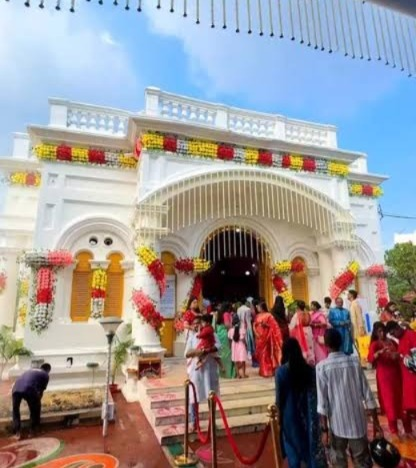
Agartala, Oct 16 (IANS) A centuries-old royal tradition continues to thrive in Tripura, where the state government funds the historic Durga Puja at the Durgabari temple in Agartala, a unique practice that has survived changes in political regimes since the erstwhile princely state merged with the Indian Union on October 15, 1949.
Held near the magnificent Ujjayanta Palace, the former royal residence, the 150-year-old Durga Puja at Durgabari temple draws thousands of devotees, including visitors from different parts of India and neighbouring Bangladesh.
The five-day festival is steeped in royal customs and rituals preserved through generations. The traditional Bodhan, marking the invocation and welcoming of Goddess Durga, heralded the beginning of celebrations at the temple on Friday.
According to Jayanta Bhattacharjee, the temple’s head priest, the tradition dates back several centuries to the reign of Tripura’s erstwhile Manikya kings. His family has served as priests at the temple for more than six generations.
“The royal family’s tradition of worshipping Goddess Durga has been preserved over the years, with several customary rituals continuing to this day,” Bhattacharjee told IANS.
He said that a few years after the beginning of the royal era in Tripura, the then-kings started the Durga Puja over 500 years ago. The royal dynasty’s headquarters moved from Rangamati (now Udaipur) in southern Tripura through several locations before Maharaja Krishna Kishore Manikya established the capital at Agartala in 1838.
The Durgabari temple stands near the Ujjayanta Palace, built by Maharaja Radha Kishore Manikya between 1899 and 1901. The palace, which once served as the headquarters of the royal administration and later housed the state Legislative Assembly, now accommodates a huge museum showcasing the history and culture of the eight Northeastern states.
The Durgabari Puja retains a distinctive administrative tradition. The West Tripura District Magistrate and Collector, traditionally known as the ‘Sebayet’, oversees the arrangements, while the surviving members of the royal family continue to be associated with the rituals. Bibhu Kumari Devi, an elderly member of the former royal family, symbolically approves the arrangements, according to those familiar with the tradition.
A district administration official said the state government had sanctioned Rs 7.50 lakh for this year’s celebrations, following the established practice.
The Dashami procession (immersion of idols) is another major highlight. The Durgabari idols lead the immersion procession and are the first to be immersed at Dashamighat, accompanied by full state honours and the state police band.
Historian and writer Panna Lal Roy said government support for the worship at temples associated with the former royal family had continued across successive Left and non-Left governments.
He said the merger agreement signed in 1949 between Maharani Kanchan Prabha Devi, the then regent, and the Indian authorities provided for the continuation of certain royal religious traditions.
“During the reign of erstwhile Tripura King Ratna Manikya (1464-1488), the Manikya dynasty issued a ‘Mudra’ (currency coin) bearing images of Goddess Durga,” Roy told IANS. A government division dealing with places of worship, known as Debarchan Vibhag, now oversees the arrangements at more than 16 temples across four districts of Tripura, Roy said.
The Durgabari Puja also stands apart for its distinctive offerings and ritual practices. According to Roy, the traditional prasad includes fruits as well as fish, meat, eggs and liquor. Although Tripura hosts thousands of community and family Durga Pujas, the Durgabari celebrations remain a major attraction because of their royal legacy, distinctive customs and continued state patronage.
Across the state, this year’s puja pandals also reflect contemporary concerns, including climate change, alongside traditional and historical themes, blending social messages with the festive spirit.
More than 3,020 community Durga Pujas and over 100 family Pujas are being organised across Tripura this year, including around 775 in West Tripura district alone, attracting large crowds and requiring extensive security and traffic management arrangements.
(Sujit Chakraborty can be contacted at sujitchakrabortyne@gmail.com)
–IANS
sc/dpb