


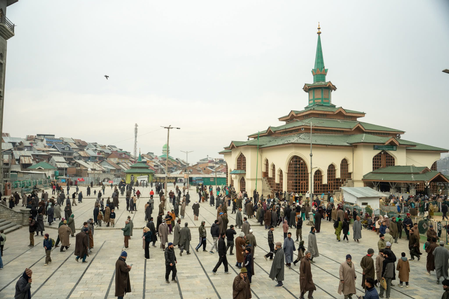
Srinagar, Oct 9 (IANS) Thousands of devotees from across the Kashmir Valley on Friday gathered at the Chrar-e-Sharief shrine of Sufi saint Sheikh Nooruddin Wali in J&K’s Budgam district to observe the annual Urs of the saint.
Revered as the patron saint of Kashmir, the Sufi saint is also known as ‘Alamdar-e-Kashmir’ and ‘Sheikh-ul-Alam’.
The J&K government declared a public holiday on Friday to mark the main day of the annual Urs celebrations.
Devotees started arriving in Chrar-e-Sharief town on Wednesday, and the gathering continued to swell on Friday.
Devotees paid obeisance at the shrine, offered special prayers and sought blessings.
The Urs celebrations begin each year with the traditional ‘Poshak Bandi’ (the ceremonial changing of the holy cloth draped over the saint’s grave). The ceremony was followed by night-long prayers.
The main day of the Urs is marked by the recitation of the Holy Quran, Naats (praises of Prophet Muhammad), and prayers for peace and communal harmony in J&K.
Sheikh Nooruddin Wali is regarded as the torchbearer of Kashmir’s unique cultural and spiritual identity.
He was born in 1377 in Kulgam district of J&K. He was the founder of the Rishi Order, a deeply indigenous branch of Sufism that intertwined Islamic mysticism with local spiritual traditions.
He is also regarded as the founder of ‘Kashmiriyat’.
He did not just preach religion; he shaped the soul of Kashmir. At a time when the region was undergoing major social and religious transitions, he introduced a philosophy based on peace, universal brotherhood, non-violence, and simplicity.
His teachings became the bedrock of Kashmiriyat, the traditional ethos of communal harmony and religious tolerance between Muslims and Kashmiri Pandits.
Instead of writing in elite languages such as Persian or Arabic, Sheikh Nooruddin Wali chose the Kashmiri language to communicate with ordinary people.
His profound spiritual insights were conveyed through four-line verses known as ‘Shruks’.
His poetry was so influential that it laid the foundation for modern Kashmiri literature and helped preserve the language through generations.
He spent years in meditation and lived a life of self-denial, dressing simply, following a minimalist vegetarian diet, and dedicating himself to serving the poor and underprivileged.
When he passed away in 1438, Kashmir’s ruler, Sultan Zain-ul-Abidin, popularly known as the ‘Budshah’ (Great King), walked in his funeral procession alongside thousands of followers.
Senior civil and police officials, including Inspector General of Police (IGP) Kashmir Sujit Kumar, visited the shrine on Friday to review security, traffic and law-and-order arrangements.
The civil administration, J&K Waqf Board and local volunteers actively managed the large gathering.
Uninterrupted water and electricity supply, medical camps and transport facilities were arranged to ensure smooth conduct of the Urs celebrations.
–IANS
sq/dan