


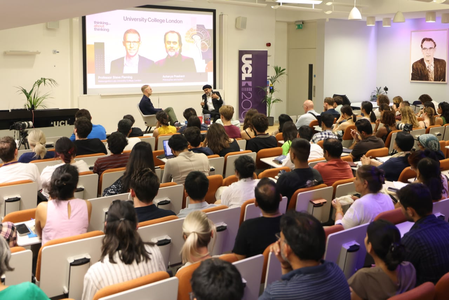
London, July 10 (IANS) Philosopher and author Acharya Prashant and the noted cognitive neuroscientist Professor Steve Fleming held a public dialogue on self-knowledge, metacognition and consciousness at University College London (UCL) on the evening of July 9.
Titled “Thinking About Thinking,” the session was the closing engagement of Acharya Prashant’s UK tour, which had earlier taken in the Cambridge Union, Oxford, the House of Lords, Queen Mary University of London, and the London School of Economics.
A hall packed with students broke into sustained applause as the two speakers took the stage, and the question-and-answer round that followed the interaction ran well past its allotted time.
The session was moderated by Dr Megan Peters, Lecturer in Computational Cognition at UCL, whose research spans metacognition, subjective experience and consciousness.
Introducing the evening, she said self-awareness is among the oldest subjects of human inquiry, and that over the past few decades metacognition has become an experimental, empirical science, putting brain research in direct conversation with contemplative traditions that have examined the self for far longer.
She introduced Acharya Prashant as a philosopher featured in the Watkins 2026 list of the world’s most influential living thinkers, whose work reaches more than 100 million people.
Professor Fleming is Professor of Cognitive Neuroscience at UCL’s Institute of Cognitive Neuroscience and a Group Leader at the Max Planck UCL Centre for Computational Psychiatry. His work on metacognition and consciousness has been recognised with honours including the Royal Society’s Francis Crick Medal and Lecture, and his book “Know Thyself: The Science of Self-Awareness” has been translated into seven languages.
Opening his remarks, he said the human mind not only models the external world but is able to place itself within that model, so that the brain can monitor its own performance, though the knowledge it forms about itself is not always accurate or useful.
Acharya Prashant drew the distinction between metacognition and self-knowledge through an analogy he returned to over the course of the evening. In a vehicle, he said, the engine produces speed, a first-order variable, while the speedometer on the dashboard measures it, so that one part of the system reads another part. This second-order reading is what science calls confidence, he noted, while the radar gun outside reports the actual speed, or the ground truth. The steady gap between speedometer and radar gun is metacognitive bias, and their moving together is metacognitive sensitivity.
“This reading is a report, not a choice,” he said, “and none of it points to the driver.” The system reading the system is metacognition, he said, whereas the driver investigating himself and finally discovering that there is no driver is self-knowledge.
Professor Fleming praised the analogy, saying he would use it in his own lectures. In experiments, he said, a person’s confidence often diverges from their actual performance, and such patterns are frequently linked to the prefrontal cortex, which appears to help build the internal model we hold of ourselves. He offered one refinement, noting that in the brain there is no dashboard sitting apart from the engine, since implicit and explicit metacognition are different levels of the same physical hardware.
Acharya Prashant said the brain does not suffer. “The body can feel pain, but there is someone else within who wakes at three in the morning and says, I am lonely, memories of the past haunt me, what am I to make of the future,” he said. “That sufferer cannot be located anywhere in the body, and it is this one that the field of self-knowledge studies.”
The ego, he said, is self-referential and self-certifying, claiming ownership over every act with the words “my thought, my body.” He described it as a computational error in the system, something like holding that two plus two equals five, which has no existence and yet can be believed in. This “someone else,” he clarified, is not a hidden entity lodged in the body but the very driver of his analogy, real as a belief and unreal as a being, and it is precisely this claimant that self-knowledge sets out to investigate.
Turning to memory, he argued that what survives from the day’s countless impressions is far from neutral. “That choice is not made by the brain,” he said. “Someone else makes it, keeping what matches its own identity.”
Professor Fleming said this view sat close to the philosopher Daniel Dennett’s notion of the “user illusion,” the idea that the sense of a single place where everything comes together is itself a construction, one that thinkers have searched for over centuries without ever finding. Yet that narrative sense of self, he added, is still grounded in how the brain works. He pointed to the classic split-brain experiments, in which one hemisphere of the brain would invent an explanation for what the other hemisphere had done, showing that even such narratives are authored within the brain itself.
Acharya Prashant responded that a system’s accuracy is structural, but honesty is always a choice. “This is not accuracy, this is honesty,” he said. “Accuracy is structural. I can build a very accurate system, but honesty is always a choice, a matter of intent. It cannot be the output of an architecture.” The ego cannot be trusted to conduct this inquiry on its own terms, he cautioned, since it is not built to look at itself but to preserve itself. Even the ego studying a book titled Ego, he said, reads only to keep itself safe.
For that reason he stressed the need for an external, neutral witness, the counterpart of the radar gun in his analogy. He described it as “a mirror standing before you, whether a true friend, a great book, or a teacher who is not a preacher but a mirror.” He offered a line in Hindi, “kisi par bharosa kar lo, khud par mat karna” (trust anyone, but not yourself), which he explained as an invitation to keep testing oneself. The witness is no substitute for inner honesty, he added, because without it a person simply breaks the mirror.
The question and answer round with students ranged across the link between the heart and the brain, consciousness in artificial systems, and the reliability of perception. Professor Fleming noted that body and brain are intimately linked, with the phases of the heartbeat shaping our sensory contact with the outside world, and suggested that the “hard problem” of subjective experience may be a moral question rather than one science can settle.
When a questioner spoke of the ego seeming to subside, Acharya Prashant observed that even its disappearance is registered by someone. “It is like the ego issuing itself a death certificate,” he said. On machine consciousness, he added that what is really being tested is resemblance, and resemblance can always be imitated. “The first question is whether we ourselves are conscious,” he said. He returned more than once to a single question. “To whom is all this? Who is it that says I am dying, I am lonely?” That one, he said, is the one who suffers, and the proper subject of self-knowledge.
Drawing the conversation toward its close, Acharya Prashant turned to the difference between thinking and insight. Thinking is a natural property of the system, he said, and even bees think and cooperate without language, a point he tied to his recent conversation with Professor Lars Chittka at Queen Mary University of London, whose research centres on the behaviour and cognition of bees. “But insight is not an action of the system,” he said. “Insight is the stepping back of the intruder that distorts the seeing.” A person already knows a great deal about himself, but the ego blocks that knowing, and only when it withdraws does insight arrive. “The seer does not survive the seeing,” he said. “If you have the intention to see, the seeing will dissolve you.”
Speaking to media after the event, Acharya Prashant said he and Professor Fleming had been climbing the same summit from two different sides of the hill. “Professor Fleming is examining the car and finding it self-driven,” he said. “That does not mean the car is always accurate, but that no external driver is needed to understand it. My work is to address that driver directly, the one who says I am the owner of life, I am the doer, and to ask him whether he is real and whether he is needed.” He described the two approaches as two sides of the same coin.
During the tour, Acharya Prashant also held dialogues with Professor Jonathan Birch, Professor Lars Chittka of Queen Mary University of London, the psychologist Dr Melanie Joy, the Cambridge-trained biologist and former Royal Society research fellow Rupert Sheldrake, and the non-dual philosopher Rupert Spira. The leg also took him to PETA’s London office and to Watkins Books, London’s oldest bookshop of esoteric and contemplative literature, where readers queued for signed copies of his books. Looking ahead, he said two major engagements await him in India, that he is at work on a forthcoming book titled “Being Without Being,” and that further London engagements are under discussion for September or October.
Acharya Prashant is an alumnus of IIT Delhi and IIM Ahmedabad and the founder of the PrashantAdvait Foundation. Drawing from Indian and global philosophy, his work reaches more than 100 million people across social media. He was also featured recently in the Watkins 2026 list of the world’s most influential living thinkers.
–IANS
skp/