
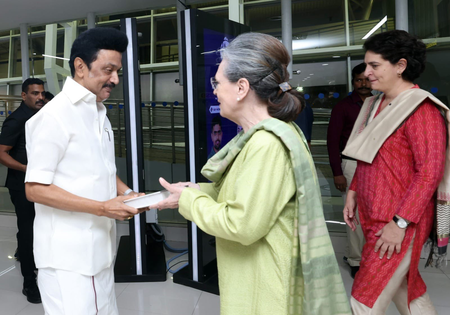
New Delhi, Nov 10 (IANS) In her memoir “Belonging: A Journey of Love”, Sonia Gandhi has opened up about the intense moral and emotional conflict she faced when the Congress party considered an alliance with the Dravida Munnetra Kazhagam (DMK) in the years following Rajiv Gandhi’s assassination.
Recalling the political landscape of the early 2000s, Gandhi notes that the moment appeared right for opposition forces to unite against the BJP-led government. Yet the idea of partnering with the DMK filled her with deep unease.
She writes that the DMK cadre had been vocal supporters of the LTTE, the terrorist group that killed Rajiv Gandhi, during the 1991 elections, and that some in the party had openly threatened him.
The Jain Commission’s report in 1997, which held a DMK leader responsible for tacitly supporting the Tamil assassins, had even prompted the Congress to withdraw support from the IK Gujral government.
“With those painful memories returning to torment me, I’d ask myself, ‘What should I do? If I join hands with them, won’t it amount to a betrayal of Rajiv?’” Gandhi recounts.
She then considered another possibility: “Perhaps Rajiv himself would have gone ahead with this alliance, if he knew it was necessary to strengthen our front against the BJP.”
A decision had to be taken urgently for a larger cause. Her heart in her mouth and hands trembling, she made the first telephone call to M. Karunanidhi.
Though they did not share a common language, the conversation was cordial.
Over subsequent meetings, they found common ground in the arts, literature and Tamil heritage, and the relationship grew cordial.
Colleagues worked out seat arrangements and campaign coordination, culminating in the formal United Progressive Alliance (UPA) on 4 May 2004.
Responding to the memoir, DMK leader TKS Elangovan said Sonia Gandhi had allied with the DMK because it was the only viable way to take on the BJP in Tamil Nadu.
He reiterated that the DMK had supported the cause of Sri Lankan Tamils and had never endorsed Rajiv Gandhi’s assassination.
The passages offer a rare personal insight into the difficult choices that shaped India’s coalition politics in the post-Rajiv era.
–IANS
sktr/dan