


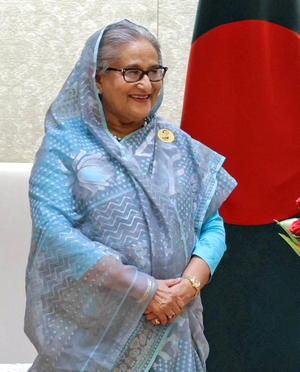
New Delhi, Aug 24 (IANS) Dhaka needs to stay firm on its demand for the extradition of former Prime Minister Sheikh Hasina, but being rigid can limit the means of achieving its own goals; thus, the policy of “no extradition, no visit” can constrict important diplomatic channels, opined a leading newspaper in Bangladesh on Monday.
“Rather, ‘the demand for extradition will remain, but the visit will be used as an opportunity for broader bilateral discussions including that demand’ seems to be a more strategically effective approach. Here, a visit isn’t a concession; rather, the trip itself can become a diplomatic tool,” popular Bengali daily Prothom Alo said.
It said that India-Bangladesh does have an extradition agreement from 2013, and Dhaka has officially requested the extradition of the former Premier, where New Delhi has acknowledged receiving the request and said that the matter is being reviewed under its legal framework.
Incidentally, the Bangladesh government held back Prime Minister Tarique Rahman’s maiden visit to India since he assumed office this year, linking it to Dhaka’s demand for the extradition of Hasina, who fled her country in August 2024 in the face of widespread student protests.
External Affairs Minister S. Jaishankar recently said that India-Bangladesh relations can work if it meets the “test of mutual interest”, adding that bilateral relations can work smoothly when the two sides find common ground.
Monday’s Prothom Alo article also reflected somewhat similar opinion.
“There’s no reason for Bangladesh to back down from this claim; it’s also tied to judicial accountability, the rule of law, and respect for Bangladesh’s own judicial process,” it stressed.
“But keeping a valid claim intact and making that claim a prerequisite for every aspect of bilateral relations are not the same thing. Bangladesh has the right to stand firm on the question of extradition; at the same time, considering which diplomatic approach is most effective to secure that claim is also part of statecraft. This is where the difference between an emotional stance and strategic statecraft comes into play,” it said.
The article further pointed out that if Prime Minister Tarique Rahman’s India visit is seen as a “concession” to New Delhi, “then a fundamental reality of diplomacy is being overlooked”, stressing that high-level visits are themselves a tool for negotiation.
“Through them, leaders send political messages, highlight their own priorities, negotiate demands, and try to shape the framework for future relations,” it stated.
To further support its argument, the article cited India’s then Prime Minister Atal Bihari Vajpayee’s Lahore visit in 1999, saying that “the Lahore Declaration set up a framework for dialogue and confidence-building measures. Even though the later Kargil conflict disrupted that process, it proves that the need for dialogue and the resolution of disputes are two separate things”.
In another diplomatic example, the piece pointed to the 1972 China visit by the then US President Richard Nixon. The Taiwan issue wasn’t resolved; it reminded, “instead, both countries continued with their differences but opened the way for dialogue and for normalising relations”.
According to the opinion piece, such precedents show that an unresolved conflict is not the same as holding back discussion for the resolution of a contention. “Rather, high-level political communication is often the most needed when faced with unresolved conflicts; because the goal of diplomacy isn’t always to achieve an immediate solution, often it’s about breaking deadlocks, creating room for negotiation, and bringing your own interests to the centre of the discussion,” it underscored.
While agreeing that for Bangladesh, Hasina’s extradition is an important issue and that it can not be left out of the bilateral agenda, the article maintained that overlooking long-term issues like water, trade, energy, connectivity, and border management over this single demand would not be diplomatically wise. “Thus, extradition will be part of the talks, but all other issues in the relationship should not depend on it,” it argued.
–IANS
jb/vd