


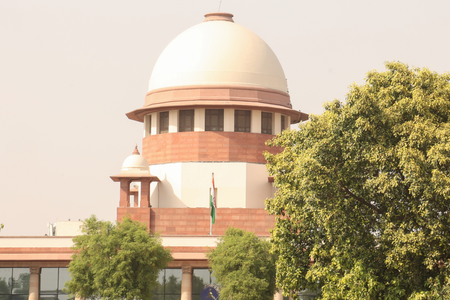
New Delhi, April 20 (IANS) The Supreme Court on Monday issued notice to the Centre, the Election Commission of India (ECI) and the Comptroller and Auditor General (CAG) on a Public Interest Litigation (PIL) seeking a ban on the announcement of “irrational freebies” by political parties ahead of elections.
A Bench of Chief Justice of India (CJI) Justice Surya Kant and Justice Joymalya Bagchi said the plea would be tagged with a batch of pending petitions raising similar issues for hearing.
The petition, filed by advocate Narendra Goswami, seeks a declaration that the promise or distribution of freebies from public funds as electoral inducements amounts to “bribery” and a “corrupt practice” under Section 123(1) of the Representation of the People Act, 1951.
“This is not a mere petition; it is a clarion call…to prevent the soul of the Indian Republic from being bartered away, election after election,” the plea stated, cautioning that the country risks being reduced to an “auction house” where votes are exchanged for material inducements.
It added that the growing trend of electoral promises such as cash doles, consumer goods, and other material benefits amounts to a “systemic, sophisticated and State-sanctioned bribe” that undermines the constitutional framework.
The petition argued that such practices create a “one-to-one transactional relationship” between voters and political parties, thereby fostering quid pro quo arrangements and vitiating free and fair elections.
The petitioner has relied on fiscal data to argue that such schemes are economically unsustainable, claiming that governments are increasingly borrowing to fund freebies, thereby imposing a burden on future generations.
Further, the PIL has sought directions to the ECI to mandate political parties to disclose the financial implications of their promises through a “Fiscal Impact Statement”, and to take action, including de-recognition, against parties violating such norms.
It has also urged the apex court to reconsider and overrule its 2013 judgment in S. Subramaniam Balaji vs. State of Tamil Nadu, contending that the ruling erroneously treated election promises as mere policy decisions and failed to account for their alleged quid pro quo nature.
Additionally, the petition has sought directions to the CAG to undertake a performance audit of freebie schemes to assess whether they meet the “public purpose” requirement under Article 282 of the Constitution.
Notably, the broader issue of poll freebies is already under consideration before the apex court in a pending petition filed by advocate Ashwini Kumar Upadhyay.
In its 2013 judgment in the Subramanian Balaji case, the top court had held that the distribution of free colour television sets by the DMK government after winning the Tamil Nadu Assembly polls could not be treated as a “corrupt practice” under the Representation of the People Act.
–IANS
pds/dpb