


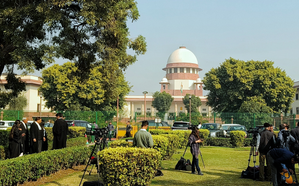
New Delhi, Sep 24 (IANS) The Supreme Court on Thursday asked the Election Commission of India (ECI) to indicate a timeframe for deciding the dispute over the name and reserved election symbol of the Trinamool Congress (TMC), observing that the matter should not be prolonged indefinitely.
A Bench of Chief Justice of India (CJI) Surya Kant, and Justices Joymalya Bagchi and V. Mohana was hearing TMC chief Mamata Banerjee’s plea challenging the ECI’s interim decision to freeze the party’s name and its “Flowers and Grass” symbol amid the dispute between rival factions.
The top court, while observing that an early decision was necessary, asked the poll panel to come up with a realistic timeframe that would allow both sides a fair opportunity to place their evidence while ensuring the proceedings are not unnecessarily prolonged.
Addressing the ECI’s counsel, the CJI-led Bench said, “Give us a reasonable timeframe in which the parties are given a fair opportunity to lead their evidence, but the matter is not prolonged, and you also get sufficient time to apply your mind. Something realistic.”
The Supreme Court directed the poll panel to indicate the proposed timeline and adjourned the matter for further hearing on September 28.
During the hearing, senior advocate Kapil Sibal, appearing for Mamata Banerjee, said the plea was not seeking a stay of the bye-elections but urged the top court to ensure that the ECI decides the dispute expeditiously.
Sibal questioned the timing of the ECI’s interim order, submitting that the dispute had reached the poll panel in July, but the decision to freeze the existing party name and symbol was taken after the bye-election process had commenced.
“Can the Election Commission delay matters and then pass orders in the midst of elections, knowing that I won’t have a remedy? You (ECI) have passed this order in the midst of elections,” Sibal submitted.
The senior counsel contended that the ECI could have passed the same order earlier, when the affected faction would have had an opportunity to seek the judicial remedy.
“They could have passed this order much before the election, and I would have had a remedy,” Sibal said.
Sibal further submitted that the Mamata Banerjee-led faction had filed its response before the ECI in July itself, but the proceedings continued, with the rival faction being granted further time.
“The order may be illegal, the order may be wrong, or the order may be right. But you (ECI) can’t pass an interim order like this. I am not saying you cannot pass it. I am saying do it before you announce the election,” he said.
He also urged the Supreme Court to ensure the dispute is decided in October, highlighting that local body elections, including the Kolkata Municipal Corporation polls, are due subsequently.
Appearing for the rival camp led by Ritabrata Banerjee, senior advocate Mukul Rohatgi said his side was ready to cooperate with the proceedings before the ECI. “We will cooperate because we want the symbol. Evidence has to be led, of course,” Rohatgi submitted, while opposing an October deadline and seeking adequate time for the proceedings.
Senior advocate Neeraj Kishan Kaul, also appearing for the rival faction, submitted that the dispute involved complicated factual questions and would require affidavits and evidence from both sides.
He said that fixing a deadline of 10 or 20 days may not be reasonable considering the nature of the proceedings.
“For the health of democracy, we have no difficulty with an expeditious decision because we know where we stand in the matter. But to say do it in ten days or twenty days may be unreasonable,” Kaul submitted.
The senior counsel also contended that the ECI possesses the power to issue interim directions while adjudicating a dispute over a political party’s name and symbol. “There are judgments of this Court saying that the Election Commission has plenitude of powers, not only under paragraph 15 but under paragraph 18. It can pass any appropriate interim direction while the issue is resolved,” he said.
The dispute arose after rival factions approached the ECI, claiming control over the TMC and its organisational and legislative structures. The poll panel had passed an interim order barring both factions from using the established party name “All India Trinamool Congress” and the reserved “Flowers and Grass” symbol, observing that the rival claims required substantive determination under Paragraph 15 of the Election Symbols (Reservation and Allotment) Order, 1968.
The ECI subsequently allotted the Mamata Banerjee-led faction the name “Mamata All India Trinamool Congress” and the “football player” symbol, while the faction led by Ritabrata Banerjee was allotted the name “Democratic Trinamool Congress” and the “envelope” symbol for the upcoming by-elections.
The interim arrangement applies to the October 6 by-elections in the Nandigram and Rejinagar Assembly constituencies.
Mamata Banerjee has challenged the freezing of the party’s established name and symbol pending final adjudication, while the rival faction has maintained its claim over the party.
The organisational dispute had also extended to Parliament, where 20 rebel TMC Lok Sabha MPs had broken away and aligned themselves with the Nationalist Citizens Party of India (NCPI), claiming recognition as a separate parliamentary group.
The Mamata Banerjee-led faction had challenged the delay in deciding disqualification petitions against the 20 MPs under the anti-defection law, maintaining that they were elected on the TMC’s symbol and that their subsequent alignment with another political formation attracted the provisions of the anti-defection law.
However, the rival faction has claimed the support of more than two-thirds of the TMC’s Lok Sabha MPs and sought recognition as a separate parliamentary group. The Supreme Court will hear Mamata Banerjee’s plea next on September 28.
–IANS
pds/dpb