


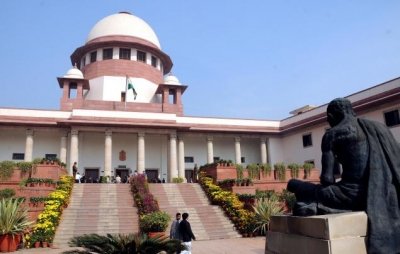
New Delhi, Aug 7 (IANS) The Supreme Court on Thursday dismissed a writ petition seeking registration of an FIR against Allahabad High Court judge Justice Yashwant Varma in connection with the cash discovery episode, terming it a “publicity interest litigation”.
A Bench of Justices P.S. Narasimha and Alok Aradhe declined to entertain the plea filed by advocate Ghanshyam Dayalu Upadhyay, observing that similar petitions had already been rejected earlier.
The matter was earlier listed before a Bench of Justices Dipankar Datta and Sheel Nagu. However, since Justice Nagu was a member of the three-judge in-house inquiry committee that had examined the allegations against Justice Varma, the case was subsequently placed before a different Bench.
The latest petition sought directions for registration of an FIR against Justice Varma in relation to the alleged discovery of burnt cash at an outhouse of his official residence in New Delhi during his tenure as a judge of the Delhi High Court. It contended that since Justice Varma had tendered his resignation in April this year, he no longer enjoyed immunity from criminal prosecution.
Earlier, the Supreme Court had repeatedly declined to entertain similar pleas seeking criminal action against Justice Varma.
The controversy traces back to March 14, 2025, when burnt currency notes were allegedly discovered in a storeroom attached to Justice Varma’s official residence after firefighters reached there to douse the blaze. Following the incident, Justice Varma was repatriated to the Allahabad High Court, and a three-member in-house inquiry committee was constituted by the Supreme Court.
The panel concluded that there was direct and electronic evidence indicating that the storeroom was under the covert or active control of Justice Varma and his family, and held that the allegations amounted to proved misconduct serious enough to warrant his removal under Article 124(4) of the Constitution.
Based on its report, then Chief Justice of India (CJI) Sanjiv Khanna forwarded his recommendation to the President and the Prime Minister for initiation of the impeachment process.
Justice Varma had challenged the in-house inquiry and the communication forwarding its findings, contending that the procedure adopted by the committee was unconstitutional and that he had been denied a fair opportunity to defend himself.
However, the Supreme Court dismissed his challenge in July, holding that the in-house procedure was “fair and just” and did not compromise judicial independence.
A Bench of Justices Dipankar Datta and A.G. Masih had held that the in-house inquiry was preliminary, ad hoc, and not final, and did not itself constitute a mechanism for removal of a judge. It had also held that the Chief Justice of India was not merely a “post office” between the in-house committee and the President or Prime Minister and could express his own views while forwarding the committee’s report in an appropriate case.
The apex court further held that the Judges (Protection) Act, 1985, did not bar internal disciplinary mechanisms such as the in-house procedure. Following the in-house inquiry report, impeachment proceedings were initiated in the Parliament after notices backed by 145 Lok Sabha members and 63 Rajya Sabha members were moved against Justice Varma.
A three-member parliamentary inquiry committee was subsequently constituted under the Judges (Inquiry) Act, 1968.
Justice Varma had challenged the constitution of the panel on procedural grounds, arguing that since impeachment notices were moved simultaneously in both Houses, the Lok Sabha Speaker and Rajya Sabha Chairman were required to act jointly.
However, the Supreme Court rejected his plea, holding that he was not entitled to any relief.
Amid the impeachment proceedings, Justice Varma tendered his resignation to President Droupadi Murmu with immediate effect, saying he was stepping down with “deep anguish”. He announced his withdrawal from the parliamentary inquiry, alleging procedural irregularities and denial of a fair opportunity to defend himself.
Justice Varma maintained that there was no evidence linking him to the alleged burnt cash and that the inquiry had proceeded on presumptions rather than proof. His resignation is learnt to have not been accepted by the President so far, and his name continues to figure among the sitting judges on the Allahabad High Court’s official website.
–IANS
pds/vd