
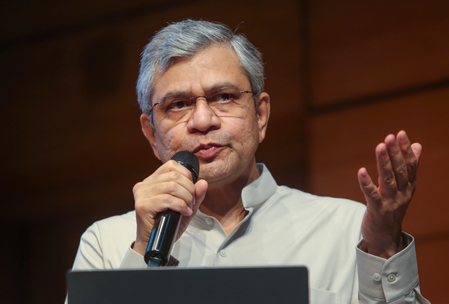
New Delhi, Oct 31 (IANS) Prime Minister Narendra Modi has approved the Northern Corridor of the bullet train network, Union Railway Minister Ashwini Vaishnaw announced on Saturday.
On the occasion of flagging off the new Vande Bharat Sleeper Express between Varanasi and New Delhi, the minister said that the corridor will begin in Delhi, connect Agra, Kanpur, Lucknow, Ayodhya, Varanasi, Prayagraj, Patna, and Siliguri, and eventually extend to Guwahati.
“Once completed, Delhi to Agra will take 59 minutes, Delhi to Kanpur 1 hour 45 minutes, Delhi to Lucknow 2 hours 12 minutes, Delhi to Varanasi 3 hours 33 minutes and Lucknow to Varanasi 1 hour 21 minutes,” according to the minister.
“Prime Minister Narendra Modi has approved the Northern Corridor of the bullet train network. This will begin in Delhi, connecting Agra, Kanpur, Lucknow, and Ayodhya, and will extend further through Varanasi and Patna, reaching all the way to Guwahati,” Vaishnaw said.
Apart from that, he dismissed the notion that the bullet train is only for the rich.
“Many people, especially those in the opposition will repeatedly spread the misconception that this bullet train is only for the rich. The fare will be very economical and much less than flight tickets,” Vaishnaw said.
The minister also said construction will be fully Make-in-India.
“The concept of the construction work for the bullet train, from pillar to girder, will be made in India. The construction is progressing rapidly. It will be fully Make in India, built by the youth and welders of India,” he said.
“The Prime Minister has approved the north corridor of the bullet train which will change the lives of many. The vision for the bullet train shared by the Prime Minister will greatly benefit the youth, the middle-income group, and artisans in small-scale industries. People will remember PM Modi for the next 100 years for this initiative,” he added.
Additionally, the first Traction Substation (TSS) for the Mumbai-Ahmedabad Bullet Train project is nearing completion at Bilimora in Gujarat’s Navsari district as work progresses on the 14 substations planned to supply power along the 508-km high-speed rail corridor.
–IANS
ag/