


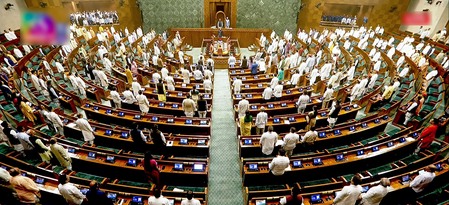
New Delhi, Aug 13 (IANS) In a role reversal of sorts in Parliament, for most part of its Monsoon session, it was the government seeking a discussion on what are being considered as contentious issues, and the Opposition declining.
For Leader of Opposition in Lok Sabha Rahul Gandhi, it was a moment of force to keep the tirade on path against the Treasury benches after his allegations on the Election Commission’s Special Intensive Revision (SIR) of voters’ list failed to make an impact in subsequent state elections.
If the SIR charges were indeed true, the Bharatiya Janata Party (BJP) and its regional allies would have done better in the southern states of Kerala and Tamil Nadu which have proved a difficult rampart for it to breach.
And Congress allies in Bihar and elsewhere found the issue, too, weak to be used as a political weapon.
Reports of NEET-UG paper leak and alleged misappropriation of Ram Mandir donations in Ayodhya came to the Congress leader Rahul Gandhi as issues that may impact poll equations in upcoming Assembly elections, especially in Uttar Pradesh.
Had the Union government indeed been in discomfort, its Ministers would not have offered to discuss these in the House.
Union Parliamentary Affairs Minister Kiren Rijiju in Lok Sabha, and Leader of the House in Rajya Sabha J.P. Nadda, along with many of their members, repeatedly invited the Opposition to a debate.
There were several meetings, including in the office of Speaker Om Birla, to find an end to the impasse.
But the Opposition, led by Rahul Gandhi, refused, insisting on “non-negotiable” terms of owning all the ills, and without a statement.
For him, this was a chance to sharpen election issues after the earlier falter, positioning himself as the voice of accountability against what he called government evasion. Thus, he dictated three non-negotiable clauses, that Union Home Minister Amit Shah must clarify that who authorised police firing on protesting students during the paper leak agitation, Prime Minister Narendra Modi apologise to students, and accountability for alleged theft of donations at the Ayodhya Ram Mandir Trust.
It was not clear how the clauses could be met without the House “framing” the “charges” by holding a discussion so that other members had their say, and giving an opportunity to the government to defend itself.
The government even attempted to merge the paper leak debate with legislation on fast-track courts, signalling willingness to address the controversy within Parliamentary procedure.
The Union Home Minister himself offered to listen to the House and state his answers, but that too was of no avail.
But all such government overtures were dismissed as “fantasy conversations”, insisting that accountability must precede any discussion, without getting into the details.
BJP leaders said that the Opposition was running away from debate, accusing them of politicising sensitive issues. They termed the refusal as obstructionist, claiming Rahul Gandhi was using Parliament as a campaign stage rather than a forum for solutions.
Traditionally, the Opposition clamours for discussion while the government resists. This time, the government sought debate, while the Opposition declined. It was a strategy to keep the spotlight on alleged government failures by blocking the Treasury bench from attempting to clarify through a procedural debate.
By refusing a discussion, the Opposition ensured headlines remain focused on government silence rather than Parliamentary debate.
Now, the INDIA bloc is likely to amplify these issues as symbols of government arrogance and corruption as the poll-going states gear up next year.
The deadlock turned into a battle of narratives, rather than public business in the Monsoon Session.
The government projected an openness to debate, while the Opposition framed the BJP as evasive and complicit.
In this role reversal, Rahul Gandhi appeared to seek a sharper electoral pitch based on education and faith, issues that resonate deeply with voters.
— IANS
jb/snj/khz