


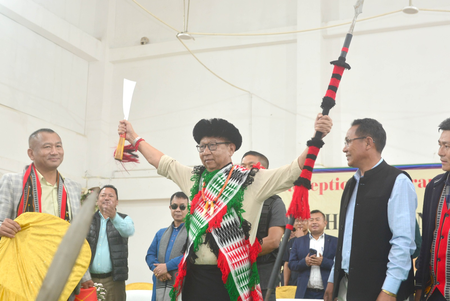
Imphal, April 10 (IANS) Manipur Chief Minister Yumnam Khemchand Singh on Friday emphasised the need for balanced and inclusive development across the state, asserting that Manipur cannot progress unless all districts advance alongside the capital city, Imphal.
During his maiden visit to the Naga-inhabited Senapati district, the Chief Minister advocated equal development and higher per capita income across all regions, stating that such progress would foster mutual understanding and harmony among the diverse communities living in different parts of the state.
“The territorial integrity of Manipur has been safeguarded by the 36 different communities inhabiting the state since time immemorial. Thus, Manipur is considered a Mini India,” he noted.
Addressing a gathering, Singh lauded the civil society organisations of Senapati, Mao, and Kangpokpi for their unwavering support for the government’s initiatives aimed at restoring peace and normalcy after the state was severely affected by unprecedented conflict.
He maintained that his road journey to the Senapati district on Friday became possible only due to their cooperation and support.
In what can be termed a significant step toward restoring normalcy, Singh is the first Chief Minister to undertake his maiden visit to Senapati district via Kangpokpi district, inhabited by the Kuki‑Zo community, after nearly three years since 3 May 2023.
He attended a reception ceremony organised by the Senapati District Frontal Organisations.
He was accompanied by Deputy Chief Minister Losii Dikho and MLAs Awangbow Newmai, Tongbram Robindro Singh, and J. Kumo Sha. The gathering began with a solemn prayer to honour the two young lives lost in the recent Tronglaobi blast in Bishnupur district. A one‑minute silence was observed in memory of the two children, initiated by the Deputy Chief Minister.
The Chief Minister was accorded a warm welcome by the people of Senapati district, led by the Naga Peoples’ Organisation, Senapati District Women’s Association, Senapati District Students’ Association, various civil society organisations, and tribal representatives.
The Chief Minister said, “First we are Indian, and then we are Manipuri,” adding that all communities must work together as one to take the state to greater heights of development.
He recalled the vision of former Prime Minister Atal Bihari Vajpayee, who believed that India cannot develop unless the Northeast develops. Singh noted that the Ministry of Development of the North-Eastern Region was established during Vajpayee’s tenure.
Responding to a memorandum submitted by the Naga People’s Organisation seeking the establishment of a medical college in the district, the Chief Minister assured the gathering that the matter would be placed for discussion in the next state cabinet meeting.
On improving the district’s sewerage system, Singh directed the Deputy Chief Minister, who holds the Public Health Engineering portfolio, to prepare a Detailed Project Report.
Regarding the relocation of the Senapati Police Station, which is currently situated in a congested area, the Chief Minister stated that the issue would be examined and appropriate action taken.
On the proposal to develop the Barak Festival site, Singh said he would consult the Tourism Department and relevant stakeholders to finalise plans and design for its development.
Deputy Chief Minister Losii Dikho, in his address, commended the residents of Senapati, comprising five tribes: Mao, Maram, Poumai, Thangal, and Zeliangrong, for their exemplary role as peace‑loving communities.
–IANS
sc/dan