
Mumbai, Oct 30 (IANS) In response to drought conditions triggered by El Niño-induced rainfall deficit, the Maharashtra government has formulated a comprehensive action plan to ensure a continuous supply of fodder for livestock across 304 drought-hit talukas.
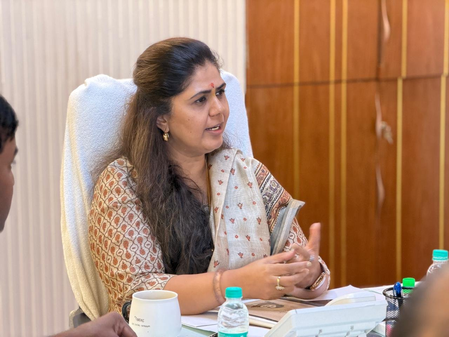
Animal Husbandry Minister Pankaja Munde on Friday announced that a minimum of 5 per cent of the District Annual Planning Fund will now be allocated for fodder production, conservation of available fodder, and the development of alternative fodder sources.
Additional measures include establishing fodder banks, promoting hydroponics and azolla cultivation, facilitating inter-district fodder transport, and implementing digital management for cattle camps.
The initiative follows recommendations made by an expert group chaired by the Additional Chief Secretary of the Revenue Department, under a cabinet sub-committee headed by Revenue Minister Chandrashekhar Bawankule.
The sub-committee accepted these recommendations on October 27, and the official government resolution (GR) was issued on October 30, 2026.
Seeds for low-water, multi-cut fodder crops will be made available via Mahabeej and other producers for the Rabi season. Cultivation will take place on agricultural university lands, taluka seed multiplication centres, and agro-corporation plots, as well as institutional land under the Animal Husbandry Department, said the GR.
Coordination among departments will promote fodder cultivation on gayran (grazing lands), grasslands, and barren or fallow lands. With support from the Water Resources Department, silt-bed (gaalpera) areas will be made available to farmers and herders.
Forest Department grass will also be harvested and stored in a timely. According to GR, the District-wise fodder banks will be established with the help of Farmer Producer Organisations (FPOs), companies, and NGOs.
To control costs, base prices have been set (excluding transport): a maximum of Rs 12 per kg for dry fodder and Rs 8 per kg for silage. A comprehensive campaign will train livestock owners in efficient harvesting, storage, silage making, urea/enzyme treatment, and the value addition of paddy straw.
Alternative techniques like hydroponics, azolla, and spineless cactus cultivation will be promoted, with pilot production planned at veterinary dispensaries.
Using fodder for industrial purposes, such as packaging, biofuels, and power generation, will be banned to prioritise animal feed. District collectors are authorised to legally prevent the transport of fodder outside the state.
A state-level online ‘Cattle Camp Monitoring and Management System’ will track animal registration, daily attendance, fodder distribution, water, veterinary care, and expenses. Camps will mandate biometric or QR code attendance, verification via the Bharat Pashudhan system, and 24/7 CCTV surveillance.
District-level drought management review committees will be chaired by Guardian Ministers, supported by executive committees led by District Collectors. Sugar factories, dairy cooperatives, gaushalas, and NGOs will participate actively, leveraging sugar cane tops, bagasse, and molasses, while utilising CSR funds for camp infrastructure and water supply, said the GR.
–IANS
sj/dan