


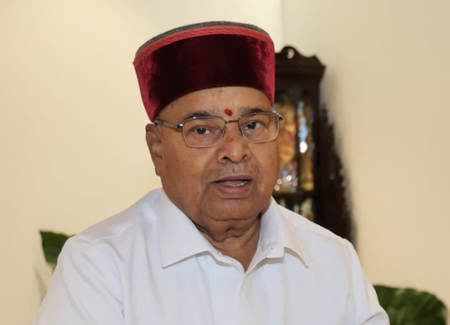
Bengaluru, Sep 22 (IANS) Karnataka Governor Thaawarchand Gehlot has written a four-page letter to Chief Minister D.K. Shivakumar objecting to the state government’s decision to restrict the rendition of the National Song Vande Mataram to its first two stanzas at official functions, warning that the move could raise constitutional concerns and conflict with the Union government’s prescribed protocol.
The letter comes amid a continuing political and legal controversy over the state government’s decision, which is also under judicial scrutiny in the Karnataka High Court following a PIL challenging the order.
In his communication, Gehlot advised the state government to reconsider its September 8, 2026 order and follow the Union government’s prevailing instructions on the rendition of the National Song.
He said restricting Vande Mataram to two stanzas was contrary to Government of India guidelines and required reconsideration in light of constitutional provisions, Central government orders, and statutory developments concerning the National Song.
Gehlot said the Union Home Ministry had issued specific orders on the National Song and National Anthem and prescribed the official version of Vande Mataram for rendition.
He noted that the Central instructions form part of the national protocol and have been circulated to states for compliance.
“Of particular relevance is the instruction that, on occasions when the National Song is sung in mass singing, the official version is to be recited,” he said.
The Governor argued that the Central instructions did not allow a state government to prescribe a truncated version of the National Song for its official functions.
He said the issue was not merely administrative but concerned conformity with the nationally prescribed protocol governing a national symbol.
Referring to the Prevention of Insults to National Honour (Amendment) Act, 2026, Gehlot said Parliament had extended statutory protection under Section 3 of the Prevention of Insults to National Honour Act, 1971, to the National Song.
He noted that the amended provision covered intentional prevention of the singing of the National Song and disturbance of assemblies engaged in such singing.
He said the statutory protection made it necessary for state executive action concerning Vande Mataram to align with the Central statutory and executive framework rather than prescribing a divergent version.
On the constitutional position, Gehlot referred to Articles 162, 256 and 257(1) of the Constitution, stating that Article 162 limits the executive power of a state to matters within its legislative competence. In contrast, Articles 256 and 257(1) require state executive power to comply with parliamentary laws and not impede the Union’s executive authority.
According to Gehlot, because the Union government exercised its executive authority by issuing specific orders on the National Song, the state’s decision to prescribe a different version could raise an avoidable constitutional question about the respective spheres of Union and state executive power.
He said the extension of statutory protection and the issuance of the Central protocol made it constitutionally and administratively inappropriate for the state government to prescribe a truncated rendition without reconciling its decision with the Central framework.
The Governor advised Chief Minister Shivakumar to reconsider the order and examine whether the two-stanza restriction could be sustained consistently with the 2026 amendment, the Ministry of Home Affairs’ instructions, and the constitutional distribution of powers between the Union and states.
He also referred to Supreme Court observations concerning national symbols and said the legal position should be examined with due regard to the statutory framework and constitutional freedoms involved.
“Therefore, in view of the above, I advise the state government to reconsider the government order dated September 8, 2026, and follow the Central government’s prevailing instructions concerning the rendition of the National Song at state functions,” Gehlot said.
He warned that reconsideration would avoid unnecessary conflict between the state’s administrative instructions and the Union’s protocol and prevent avoidable constitutional litigation over executive powers.
–IANS
mka/dan