


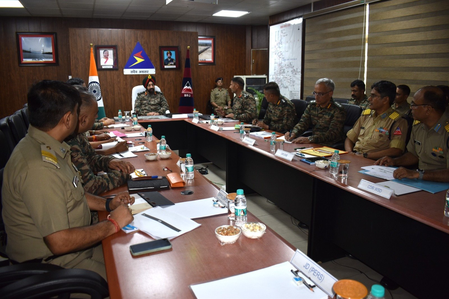
Kolkata, Sep 25 (IANS) Lt Gen Harpal Singh, Director General, Border Roads (DGBR), visited the Army’s Northern Command headquarters in Udhampur, Jammu and Kashmir, on Friday and held discussions on strategic road development and infrastructure projects in forward areas.
Lt Gen M P Singh, Chief of Staff, Northern Command, and Maj Gen Salil Pandey, Chief Engineer, joined the deliberations with the DGBR. Lt Gen Harpal Singh also visited the headquarters of Project Sampark of the Border Roads Organisation (BRO) to review the progress of ongoing works.
He interacted with BRO personnel, appreciated their dedication and commitment, and urged all ranks to maintain the pace of development and expedite critical border connectivity projects.
Project Sampark is operationally in charge of most districts of Jammu. Out of the 10 districts, it operates in Reasi, Kishtwar, Poonch, Rajouri, Kathua, Doda, Udhampur, Ramban and Samba. It also handles strategic projects in Pathankot district of Punjab. Its area of responsibility is largely hilly or mountainous, including the Pir Panjal ranges, which separate Jammu from the Kashmir Valley.
Project Sampark was carved out of Project Beacon on January 1, 1975, after a need was felt in the early 1970s to create a new project for all-road development south of the Pir Panjal ranges under Northern Command. Since then, it has constructed, improved, and maintained the strategic road network in nine border districts of Jammu and one in Punjab.
The project began in 1975 with 500 km of existing road network and a financial outlay of Rs 3.40 crore. At present, nearly 2,963 km of road network is under construction and maintenance, with an annual budget of about Rs 1,000 crore.
In addition to roads, Project Sampark maintains 140 km of Ditch‑cum‑Bunds (DCB) spread across the 10th, 26th and 29th Infantry Divisions of the Northern and Western Commands. DCBs are tactical obstacles and defensive fortifications to stall enemy tanks and armoured personnel carriers.
The project has also contributed to socio‑economic development by opening new trade routes and connecting remote areas with the rest of the country. Despite difficult terrain and harsh climatic conditions, it has provided vital support to defence forces and relief to local populations along the Line of Control.
Project Sampark also employs more than 8,500 skilled and unskilled workers from Jammu and Kashmir, helping them integrate into the mainstream.
–IANS
jg/dan