


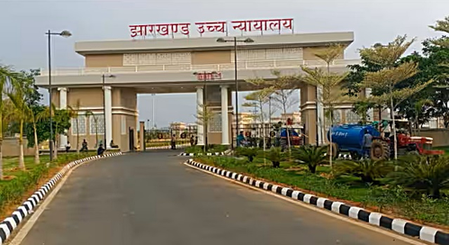
Ranchi, Sep 14 (IANS) Taking a stern view of allegations of air and water pollution caused by private industrial units in Ramgarh district, the Jharkhand High Court has issued a series of directions to the Jharkhand State Pollution Control Board (JSPCB) including mandatory regular and surprise inspections of the units.
Disposing of a Public Interest Litigation (PIL) filed by Ram Kishor, a division bench of Chief Justice M.S. Sonak and Justice Rajesh Shankar observed that the right to a clean environment forms an inseparable part of the right to life guaranteed under Article 21 of the Constitution.
The petition alleged that some Ramgarh-based industrial units were emitting smoke and dust from their chimneys and polluting the Damodar River and nearby water sources.
The court directed the Hazaribagh Regional Officer of the JSPCB to inspect both industrial units at least twice every year. One of these inspections must be conducted without prior notice to assess the actual state of pollution-control measures in place.
The bench further ordered that if a unit’s Continuous Emission Monitoring System records emissions exceeding prescribed limits for more than 48 hours, the Pollution Control Board must issue a show-cause notice to the industry concerned within seven days.
The court also laid down timelines for a fresh assessment of water pollution. It directed authorities to collect water samples within three months from locations near Viva International School and from upstream and downstream stretches of the Damodar River.
The samples are to be tested at an accredited laboratory, and the findings submitted to the Ramgarh Deputy Commissioner.
In addition, the division bench ordered a detailed review of the environmental clearances, Consent to Establish (CTE), and Consent to Operate (CTO) granted to both companies.
Relevant documents will be scrutinised over the next two months and consolidated records prepared. Appropriate legal action will be initiated if any approval is found to have expired.
To ensure compliance with its directions, the court instructed the concerned authorities to file compliance affidavits within four months. It also granted liberty to the petitioner to move an interlocutory application in the same matter in the event of any future violation of the court’s directions or deterioration in pollution levels.
–IANS
snc/skp/vd