


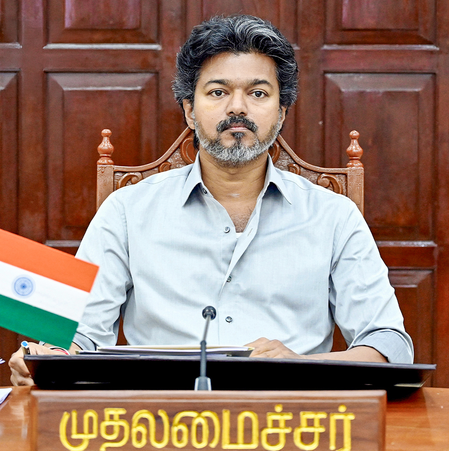
Chennai, Sep 4 (IANS) Tamil Nadu Chief Minister C. Joseph Vijay’s Janmashtami greetings on Friday, wishing people joy and invoking Lord Krishna’s teachings is being seen in certain quarters as a shift in political identity in a state long following Dravidian rationalism, which distinguished it from the religiously infused politics of most other Indian states.
Janmashtami is widely celebrated across India to mark the birth of Lord Krishna.
Many political leaders extend wishes on the occasion.
In Tamil Nadu, the Dravidian movement has long been defined by its rejection of religious orthodoxy and its embrace of rationalist, secular, and social justice principles.
Emerging in the early 20th century under the leadership of Periyar E.V. Ramasamy, the movement sought to dismantle caste hierarchies and Brahminical dominance seen as being practiced through Hindu rituals and mythology.
This ideological foundation went on to influence Tamil Nadu politics, including leaders such as C.N. Annadurai and M. Karunanidhi.
Annadurai, founder of the Dravida Munnetra Kazhagam (DMK), had balanced Tamil cultural pride with secular politics, avoiding overt religious symbolism, and promoting Tamil literature, language, and identity.
His successor, Karunanidhi, was even more explicit in his rationalist leanings, often critiquing Hindu rituals and mythology in his writings and speeches.
There are also no publicly reported greetings on Hindu festivals from Karunanidhi’s son and former Chief Minister M.K. Stalin.
Against this backdrop, Chief Minister Vijay extending greetings on the occasion of Sri Krishna Jayanti represents a significant deviation.
His message, which invoked Lord Krishna’s teachings on dharma, righteousness, and love, marks a cultural and ideological shift that departs from the said rationalist foundations of Dravidian politics.
His words signal a willingness to integrate religious symbolism into political discourse, something that Dravidian leaders reportedly resisted.
Some analysts interpret this move as part of CM Vijay’s broader political strategy.
As the leader of Tamilaga Vettri Kazhagam (TVK), the Chief Minister may seek to carve out a distinct identity in Tamil Nadu’s crowded political landscape.
He thus appears to be experimenting with a hybrid model that blends Tamil pride with selective religious inclusivity.
Vijay’s background as a popular actor gives him a unique advantage in connecting with younger voters, many of whom may not be as ideologically tied to Periyarist rationalism.
The TVK leader may also be attempting to appeal to Hindu sentiment while still maintaining a broader Tamil identity.
This strategy reflects a recalibration of Dravidian politics, where cultural inclusivity is being tested against ideological purity.
The hugely popular M. G. Ramachandran, popularly known as MGR, who established the foundation of the All India Anna Dravida Munnetra Kazhagam (AIADMK), though said to have never reportedly subscribed to the atheist ideology of Periyar’s Dravidar Kazhagam (DK), though avoided overt religious endorsements.
He preferred to focus on welfare schemes and his own cinematic appeal.
Now, Vijay’s approach appears to represent devotional symbolism with political messaging.
While there is a chance that it may alienate hardcore Dravidian supporters, it is likely to attract moderate Hindu voters who value cultural inclusivity.
The implications of this shift will be known in time, where Tamil Nadu’s political identity has long been anchored in Dravidian rationalism, which distinguished it from the religiously infused politics of other Indian states.
On the one hand, it may broaden Vijay’s appeal and reshape the ideological contours of the state. On the other, it could dilute the clarity of Dravidian politics and invite backlash from rationalist groups who may see it as a betrayal of foundational principles.
–IANS
jb/khz