


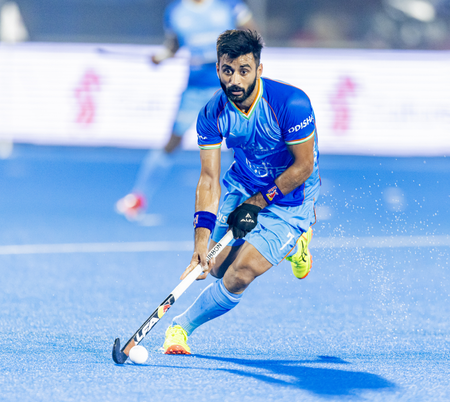
New Delhi, July 28 (IANS) With the FIH Hockey World Cup 2026 less than a month away, India’s men’s and women’s hockey teams are sharpening the finer aspects of their game, with the midfield unit emphasising communication, awareness and decision-making as they prepare for the sport’s biggest stage.
While forwards often receive the plaudits for scoring goals, midfielders remain central to a team’s structure, linking defence with attack, controlling possession and dictating the tempo of matches. As India enters the final phase of its World Cup preparations, several of the team’s midfielders have shed light on the demands of the role and the work that goes into creating opportunities.
Veteran midfielder Manpreet Singh, who is set to become India’s most-capped player in FIH World Cup history during the tournament, said the role extends well beyond simply distributing the ball.
“As a midfielder, I believe my biggest responsibility is to connect the entire team. We (midfielders) are the link between defence and attack, so it’s important to maintain the team’s structure and rhythm throughout the game. Beyond passing and defending, I focus on creating space, supporting teammates, making quick decisions and ensuring we stay organised in every phase of play. A midfielder has to be involved in almost every moment of the game,” he shared.
The Indian men’s team has been drawn in Pool D alongside England, Pakistan and Wales, with Manpreet expected to play a pivotal role in orchestrating play from the middle of the park.
His teammate Hardik Singh echoed those sentiments, stressing that communication and game awareness are just as important as technical ability in modern hockey.
“Communication and awareness are extremely important for a midfielder because you need to keep the team balanced throughout the game. If you concede too many turnovers, you give the opposition more opportunities to take control. A midfielder has to understand when to join the attack, when to hold position, and recognise the right moments to support the forwards. These qualities develop with time and experience, and the better your awareness and communication, the more effective you become in helping the team,” Hardik explained.
The upcoming edition will also mark the first time the men’s and women’s FIH World Cups will be staged simultaneously at the same venues. India’s women’s team, buoyed by its recent FIH Nations Cup triumph, has been drawn in Pool D with China, South Africa and England.
Women’s midfielder Neha highlighted the extensive preparation that goes into developing coordination between defenders, midfielders and forwards.
“We need to build chemistry with both defenders and forwards. We regularly analyse video clips, and during training we focus heavily on eye contact, body position, and pre-scanning before receiving the ball, because these small details help us make better decisions during matches. During pressing, we need to know where to apply pressure, and when we have possession, pre-scanning helps us keep the game flowing. These are aspects we continuously train ourselves in,” said Neha.
For Vivek Sagar Prasad, one of the biggest challenges in midfield is deciding whether to move the ball quickly or carry it forward, depending on the situation.
“When I receive the ball, I first assess the situation before deciding my next move. I believe the ball always travels faster than the player. So whenever possible, I prefer quick passing combinations to move the play forward. At the same time, it’s important to recognise when to carry the ball. In the attacking half, I am more willing to take risks, but in our own half, if I’m under pressure, I focus on protecting possession, earning a foul if needed and helping the team restart play,” Vivek said.
Sakshi Rana, meanwhile, underlined the importance of composure and anticipation when operating in congested areas of the field.
“When I receive the ball under pressure, my first thought is to stay calm. I try to scan the field before receiving the ball, so I already know where my teammates and opponents are. That helps me make quick decisions, whether it’s passing, carrying the ball forward or switching the play,” Sakshi said.
As both Indian teams complete their final preparations for the World Cup, the focus remains on ensuring the midfield continues to serve as the engine room of the side. Through constant communication, intelligent positioning and split-second decision-making, the playmakers hope to provide the platform for India to challenge for honours on home hockey’s biggest stage.
–IANS
vi/bsk/