


New Delhi, May 18 (IANS) With several international cartels being busted by the Indian security agencies, the shift to produce narcotics locally has begun. Smuggling drugs into the country is not as easy as it used to be, courtesy the drug-free initiative that has been initiated by the Prime Minister Narendra Modi government.
Union Home Minister, Amit Shah, has on numerous occasions said that no effort will be spared to crack down on the narcotic cartels.
Since the launch of this initiative, drugs running into crores of Rupees have been seized by various agencies across the country.
These crackdowns have made the cartels, most of which are backed by Pakistan’s ISI, desperate.
An official explained that there is real-time Intelligence and seamless coordination by the central and state agencies which has led to the busting of so many consignments.
The official said that earlier the trend was to get drugs into the Indian markets and then supply them.
Over the years, the modus operandi changed and drugs that came into the Indian market were not only meant for local consumption.
These drugs were being smuggled into countries such as Maldives, Sri Lanka and most recently Thailand.
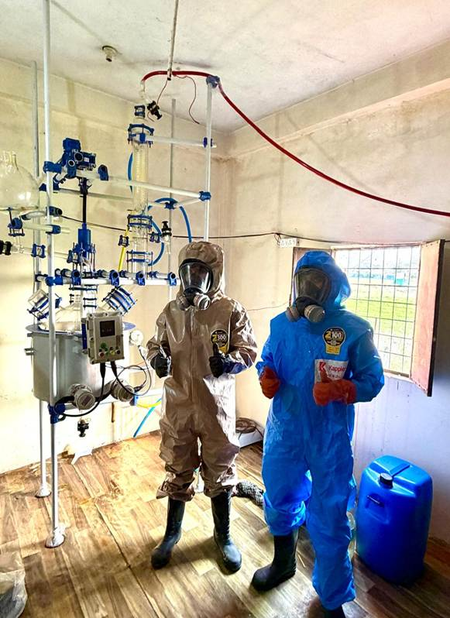
Today, what these cartels intend to do is set up laboratories across the country and locally produce the drugs. Cartels have directed their local stooges to produce narcotics in very high quantities.
This is not only meant for local consumption, but also to be smuggled into countries across the world.
An Intelligence Bureau official said that the worry is that these cartels are no longer treating India as just a landing hub. They are making it a massive production hub and 80 per cent of the drugs produced in the country are meant to be smuggled out of the country to nations across the globe.
The ISI in particular has been finding it hard to smuggle drugs into India. Its two main entry points,Jammu and Kashmir and Punjab, have been secured to such an extent that 8 out of every 10 consignments are busted.
Various techniques such as the use of drones to bring in the drugs have been tried, but this modus operandi, too, is failing heavily.
The police forces and the border agencies have enhanced surveillance capabilities and today handling the drones has become relatively easier when compared to what it was about two years back, an official said.
For cartels, especially the ones that are backed by the ISI, the supply of narcotics is extremely vital. It is the money that is raised through drug trade that finances terror.
With the ISI desperate to revive its terror groups in the aftermath of ‘Operation Sindoor’, it becomes important for it to fuel the narcotics trade.
During the operation, Pakistan did not just lose face, but also suffered immense losses in terms of terror infrastructure. In order to piece all of this together once again, it is in desperate need of funds.
Another official said that the Modi government’s resolve to tackle the narcotics menace with an iron fist has hurt the ISI and its cartels the most.
While the Indian agencies have been handling the international operations of these drug cartels, the challenge currently is to tackle the units that are manufacturing narcotics locally, the official also added.
The official further said that these cartels are aware that the agencies will figure out ways to tackle the local operations sooner or later. In the meantime, the intention is to set up as many local laboratories as possible and produce drugs in massive quantities.
They want to get this done before their operations get busted more frequently and raise as much funds as possible.
Among all the players that are part of this racket, the most desperate are the cartels backed by the ISI. They are under immense pressure from the ISI to ramp up operations and raise funds so that terror groups are taken care of the official also added.
While these cartels ramp up operations, signs of their modules being busted are already being seen. The seizure of a massive consignment of Captagon, also known as the ‘Jihadi drug’ or ‘rage drug’ is a sign that the Indian agencies are cracking down heavily on local modules.
Captagon tablets worth Rs 182 crore was seized from Gujarat’s Mundra Port and Delhi’s Neb Sarai area by the Narcotics Control Bureau (NCB) as part of ‘Operation Ragepill’ that was announced by Home Minister Shah.
The illegal laboratory that was producing this drug operated out of a pharmaceutical unit in Dehradun, Uttarakhand. A Syrian national and the Dehradun factory owner were arrested.
The drugs were intended to be smuggled into the Middle East/Gulf region.
“The Modi government is resolved for a ‘drug-free India’… Our agencies have achieved the first-ever seizure of Captagon, the so-called ‘Jihadi Drug’,” Home Minister Shah said post the operation.
–IANS
vn/rad