


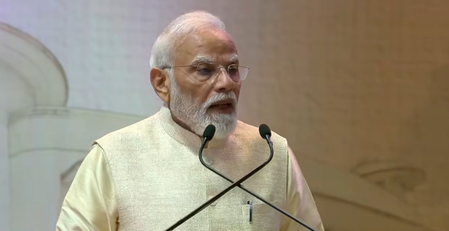
New Delhi, Oct 1 (IANS) Prime Minister Narendra Modi, while participating in the centenary celebrations of the Union Public Service Commission (UPSC) on Thursday, said that India has moved from an era when the government was considered the sole provider and guardian of citizens to an era where ‘Nagrik Devo Bhava’ is the guiding principle, with every citizen treated with the highest priority.
Addressing the gathering, PM Modi said the UPSC has fulfilled its responsibilities effectively over the past several decades and stressed that the focus should now shift from its history to the country’s future.
“Over the past few decades, the UPSC has fulfilled its responsibilities in an excellent manner. We have already discussed this extensively on the stage as well. Therefore, I neither want to repeat it nor go into its details. Moving beyond history, the future of India now awaits us,” he said.
“After history, now we have the future that is waiting for us. We have lived through a quarter of this century. The upcoming 20-25 years, for India, for the people of this country and for all institutions, are very crucial,” the Prime Minister added.
PM Modi said institutions such as the UPSC and State Public Service Commissions would play an important role in providing the kind of governance required to build a ‘Viksit Bharat’.
“For a Viksit Bharat, the kind of governance the country now needs will be enabled to a great extent by institutions such as the UPSC and the State Public Service Commissions. The young people you are recruiting today will play an important role in building a Viksit Bharat. They will also be among the biggest beneficiaries of that Viksit Bharat,” he said.
The Prime Minister said the selection of candidates for public services should be guided by two key criteria — the “nation first” and “citizen first”.
“So, for that, we will have to remember two criteria. The first one is nation first, and the second one is citizen first. These are the two principles on which all selections will be made,” he said.
“When candidates are selected on this basis, it will be very easy to achieve our goals,” PM Modi added.
He said India in 2047 would be significantly different from the country today, with increasing urbanisation, a narrowing gap between villages and cities and greater aspirations among citizens, particularly the youth.
“India in 2047 will be very different from the India of today. India will be more urban compared to today. The gap between villages and cities will narrow. And the aspirations and expectations of our citizens, especially the youth, will be much greater. We can already see this change happening today,” he said.
PM Modi said public services would also need to keep pace with the growing expectations of citizens in an era of instant delivery and technological advancement.
“So, it will also be important to see that these services are achieving the speed of instant delivery in this age,” he said.
“When AI can process thousands of documents within moments, and when the government has access to real-time data, citizens want quick solutions. This changing mindset also demands new changes from our civil services. Therefore, we will have to align our selection parameters and recruitment processes with the needs of the future,” he added.
The Prime Minister emphasised the need to attract young people towards public service rather than merely public office.
“We will have to bring such youths who are not attracted to public offices but should be attracted towards public service,” PM Modi said.
He also recalled his interactions with trainee officers and advised them to document their motivation for joining the civil services.
“Many of you may be familiar with the fact that whenever I meet trainee officers, I tell them to write down, right at the beginning, in their own words, why they joined the civil services. As time passes, responsibilities increase, and new challenges arise. At such times, that small note reminds them of their original purpose. It also becomes a self-appraisal tool for them,” he said.
PM Modi said the government’s approach towards citizens has also changed over time.
“We have seen an era in the past when it was believed that the government was the sole provider and guardian of the people. But today, we are in an era where our mantra is ‘Nagrik Devo Bhava’ — every citizen of the country is no less than a deity for us. Serving citizens is our highest priority,” he said.
He further said selection processes at both the national and state levels should reflect this approach.
“At both the national and state levels, we should design our selection processes in accordance with this spirit. Based on the parameters of pro-people, proactive and good governance, we have to provide the country with professionals who have the sensitivity to understand the difficulties faced by the poor,” he said.
The Prime Minister also called for efforts to reduce the examination cycle, noting that steps had already been taken towards making the process shorter. “We should also work on reducing the examination cycle. However, we have seen in the gallery that they have made it shorter,” he said.
–IANS
jk/dpb