


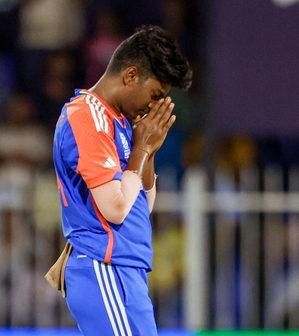
For most cricketers, life about playing in a global franchise T20 league is mostly about showcasing your skills and then picking up lessons from other players and coaches. For Pooja, the seam-bowling all-rounder currently playing for Barbados Tridents in the WCPL, it is something else – to live and follow the new-found philosophy acquired via a shoulder injury layoff.
Pooja isn’t a stranger to injuries needing surgeries — she went through a right-knee ACL reconstruction in 2017, before she had played for India, and was followed by a second operation on the left knee the following year. But the shoulder surgery done after the 2024 Women’s T20 World Cup has been a perspective-altering event for Pooja.
The surgery was done on a torn supraspinatus tendon in her shoulder. Rehab at the CoE ran to almost nine months, before a hamstring injury delayed her return to competitive cricket. But once the fitness certificate came through she turned out for RCB in the fag end of the WPL, where the side won the title and has since played in whatever tournament has been available to her.
Navigating loneliness despite being around a plethora of players and specialists was hard for Pooja, who picked up a few wise lessons. “There’s a lot to learn because you spend a lot of time alone while in CoE, Bengaluru and you don’t want to go back to your old life because cricket is a team sport and we always do training or sessions with the team.
“But when you go to the rehab, the feeling of loneliness is very strong, and it eats you up from the inside. At the same time, it teaches you a lot and makes you stronger. You build a lot of knowledge – you learn about your body, training, physiotherapy and load management. So, there’s a lot to learn because people like me say that I’ve had three surgeries and spent a lot of time alone,” Pooja told IANS in a select virtual interaction organised by FanCode, the official broadcaster of WCPL in India.
Whenever a player has to face the rehab and recovery route, their go-to person is now Pooja. “A lot of players don’t even call their physios – instead, they call me and say, ‘I’ve had an injury. What should I do?’ They sometimes have fun with me. In CoE, the physios said that I have enough knowledge to deal with small injuries by myself. It’s because you live in that atmosphere, you get that knowledge and learn a lot about yourself.”
Support also came from the people in her life – close friends, family, CoE trainers, physios and the management at RCB – consisting of coaches, trainer, physio and captain Smriti Mandhana. “There’s a time when after an injury, there are a lot of biomechanical changes. In India, there is no awareness of it and people don’t have knowledge.
“They compare the previous Pooja with the current Pooja. Like if someone has come from a knee surgery, even if they get a fitness certificate after nine months, the biomechanical changes in the ground will still be there. If someone is limping, it is very easy to judge in India that she is limping because he is injured.
“But she is not injured, as she is playing, and has got a certificate. If she is bowling, it means she is fit. Biomechanical changes will be there all the time in life. How the player manages to play is down to her talent.
“If any player is playing at a higher level, no one is 100 percent fit. There are a lot of matches like WPL, international, bilateral series and domestic games. Everyone manages to play well. I felt really good that RCB supported me a lot. At one time, the pace of bowling was going up and down.
“They told me to come and will take care of me and even said that my batting is enough for them. That helps a lot because at one time, I thought that I was not enough. When you have a lot of talent within you, we don’t understand it at that time. When someone tells you that you can do this, that moment changes a lot,” she explained.
For all the changes the shoulder surgery brought to Pooja’s life view, one thing has been thankfully untouched: her bowling action. She watched bowlers who keep hurting long after the surgeon has called the healing complete and the strength coach has signed off the numbers, and who end up rebuilt at the crease because nobody can find another answer.
That has never been her, and she says so with a touchwood attached. The one concession is at the start of a session – a body coming back to load does not simply accept it because you have turned up, so her warm-up runs longer than it used to. The rest is a matter of getting reacquainted with her skillsets.
“Actually, I don’t think about the future. If the body responds at that time, and there is a little pain, then the coping mechanism of the body is such that it holds. Yes, when you bowl after 2-3 months of injury, the load is different. The body is not used to the load. Initially, you will feel pain for 2-3 days.
“But later on, you will feel that it is normal and the same is said by physios. You are not used to the load, but then you like it. Yes, you feel a little fear that when you fall, your fear that it shouldn’t get worse. But when you keep doing it, you get used to all these things. Then there comes a moment when you go up in life, and then it doesn’t matter.”
The RCB connection is hard to miss, considering Pooja had a setback in her hamstring while trying to become match fit and eventually came at the final phase of WPL phase in Vadodara, albeit as a specialist batter. “They picked me during the rehab, and that was a very big thing for me. They showed so much faith that if Pooja gets fit, she can do batting, bowling or fielding for us in any department.
“But getting confidence from a franchise is the biggest thing. I joined the team very late. So, I didn’t get a chance to work that much. But whatever small talks I had with Anya (Shrubsole, assistant coach), she focuses a lot on planning. Like, we put in the balls that we know and during the tournament, we can’t work much on the technical side.
“So, the main thing I learnt from them is that they focus a lot on planning. Like, what should be your plan A, plan B, plan C. If you’re sending down a bouncer, yorker, slower ball or a stock ball, then you need a specific field. If that field doesn’t work, then what’s your plan B? So, I got to learn a lot from them in terms of planning.”
Back home in the MP T20 League, where she captained Chambal Ghariyals to winning the title, she barely bowled not due to the injury, but because she counted the youngsters in the squad, who were waiting for a game to showcase their skills. Pooja also likes what is coming through behind her and thinks the coaching has sharpened since her own age-group days.
“When small kids come to my hometown and ask questions, my answer is that the game has become very advanced. It’s important to bring those three skills and now they are also learning like WPL and different tournaments are happening. So, their coaches have become very smart as they are moulding the kids to be all-rounders. So, it’s looking good.”
Though Pooja hasn’t set the WCPL on fire, her mood is still cheerful. “Yes, it’s been great. We haven’t had a lot of matches so far. But the atmosphere of the team and the practices we’ve been doing and the matches that are coming up, we’re very positive about that. Actually, our first match didn’t go so well. But the bond of our team is great.
“It’s very important for us and even more important for women’s cricket because the way women’s cricket is developing, and when we play in public, we get to perform in front of a lot of fans. We then get to represent our country, and if we don’t get a lot of opportunities, then it becomes a very good tournament to make a comeback into the team.”
It’s going to be close to two years since Pooja donned an India jersey, and while the comeback may happen, she doesn’t think too much about the future, as she now prefers to go with the flow. “I have done a lot of things in my life and we tend to plan a lot for doing this and that in our respective lifetime.
“But I don’t know how many things I have achieved in my life out of it. Most of the time, we are result-oriented. We think more about the result. Everyone’s wish list and manifestations are about the result. My go with the flow philosophy is due to the fact that I don’t have to think about or to manifest for the result.
“I have to manifest for the moment and live in that moment. If it is today’s moment and my match is happening, then my routine before the match should be my best routine. I should bowl four overs and do a good warm-up before the match. Whatever the result is, if I get two wickets, it is fine. If not, it is still fine.
“I should follow the process as we become result-oriented a lot and forget the process. If the result is not clear, we get a lot of disappointment. But now I don’t want all of that – I want to live in the present and be in that moment.”
–IANS
nr/bsk/