


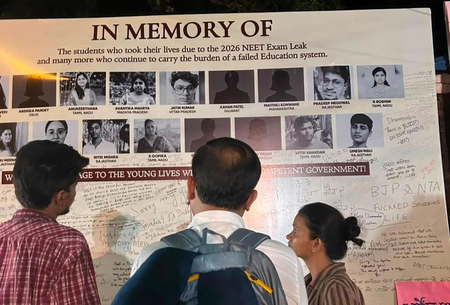
Ahmedabad, July 26 (IANS) The father of 17-year-old NEET aspirant Kahaan Patel, whose death by suicide in June became one of the most widely discussed tragedies linked to the NEET-UG 2026 controversy, has thrown his support behind the Centre’s proposed amendments to strengthen India’s anti-paper leak law, saying speedy investigations, fast-track courts and tougher punishment are necessary to restore confidence in the examination system.
Speaking to IANS ahead of the introduction of the proposed amendments in Parliament on Monday, Kahaan Patel’s father Prashantkumar Patel, a criminal lawyer by profession, said he supported provisions that would mandate time-bound investigations and trials, increase prison terms and fines for paper leak offences, and create a stronger legal framework against organised examination fraud.
“If the government has brought these provisions, then I obviously support them. As a lawyer, whenever the government talks about speeding up judicial proceedings, I am happy. We get exhausted seeing repeated adjournments in court. Clients come with only one hope… that justice should come quickly. If investigations, day-to-day hearings and appeals are completed within fixed timelines, it is a very good step,” he said.
According to the draft proposals expected to be tabled in Parliament on Monday, the government plans to amend the Public Examinations (Prevention of Unfair Means) Act to substantially strengthen punishment for examination fraud.
The proposed changes include increasing the minimum punishment for paper leak offences from three years to five years, with imprisonment extending up to 10 years and fines reaching Rs 50 lakh.
For organised paper leak syndicates, the minimum punishment is proposed to rise to seven years, along with fines of up to Rs 10 crore.
The amendments also envisage the constitution of specialised investigative teams, completion of investigations within two months, day-to-day fast-track trials to conclude within three months of filing chargesheets, and disposal of appeals, wherever possible, within another three months.
Patel said such measures could improve public confidence in the criminal justice system if implemented effectively.
“These reforms will definitely help. But implementation is equally important. Governments have announced fast-track courts before as well. The real question is whether these timelines will actually be followed at the grassroots level. Still, if the government has accepted that reforms are needed and has brought these amendments, I support them,” he told IANS.
Kahaan Patel died by suicide on June 18 after the cancellation of the original National Eligibility cum Entrance Test (Undergraduate) examination held on May 3 and the announcement of a re-examination following allegations of a nationwide paper leak.
His father said Kahaan had expected to score around 650 marks in the first examination and had been confident after finishing the paper.
According to Patel, coaching institute assessments had estimated his son’s score at around 649 before the examination was cancelled.
“My son became deeply distressed after the government announced the re-test, believing that months of hard work had effectively been nullified,” he said.
He recalled that Kahaan increasingly expressed anger towards the examination system, although family members did not realise the extent of his emotional distress until after his death, when his friends and coaching teachers described noticeable changes in his behaviour.
Following Kahaan’s death, Patel travelled to New Delhi and twice visited the student protest site at Jantar Mantar, where protests led by the Cockroach Janata Party (CJP) demanded accountability for the paper leak, resignation of then Union Education Minister Dharmendra Pradhan, compensation for families of students who died by suicide and protection for protesters from legal action.
Patel said seeing students continue their peaceful protest despite police action convinced him to support their campaign.
“I personally observed demonstrations in Delhi, Ahmedabad and Surat. I feel the police action (lathi-charge) against the students was unwarranted. Political parties should also not overshadow student-led movements. My son is no longer with us, but these children were fighting for every student. That is why I supported them,” he said.
On Saturday, one of the principal demands of the protesters was met when Dharmendra Pradhan resigned as Union Education Minister, taking what he described as moral responsibility for the crisis.
The government subsequently assigned additional charge of the Education Ministry to Pralhad Joshi after prolonged nationwide protests and three rounds of discussions with student representatives.
Patel admitted feeling a sense of relief after the resignation. “It felt like I had finally been able to pay tribute to Kahaan. My son’s anger was about accountability. The government accepted responsibility, even if it came late,” he said.
He nevertheless maintained that accountability should extend beyond resignations. “The government took time to respond and I questioned that delay. But if it has now accepted responsibility and is bringing meaningful reforms, then those reforms deserve support,” he told IANS.
The father also revealed that, without informing even his family, he had observed a personal fast after witnessing the determination of students protesting in Delhi despite police action.
“When I saw the students return to Jantar Mantar the same night after everything they had gone through on July 20, I decided privately that I would also stop eating. It was something personal. I did not announce it publicly,” he said emotionally.
The NEET-UG controversy began after allegations that the May 3 examination paper had been leaked before the test.
The Centre subsequently cancelled the examination, handed the investigation to the CBI and conducted a nationwide re-examination on June 21 for more than 20 lakh candidates.
The episode triggered weeks of protests, parliamentary disruption, legal challenges and renewed scrutiny of India’s examination system.
With Parliament expected to debate the strengthened anti-paper leak legislation, Patel said he would be watching closely.
“As both a father and a lawyer, I want these provisions to become reality. If investigations become faster, trials become time-bound and organised paper leak networks face stringent punishment, then future students may not have to suffer what Kahaan and thousands of others went through,” he concluded.
–IANS
mys/uk