


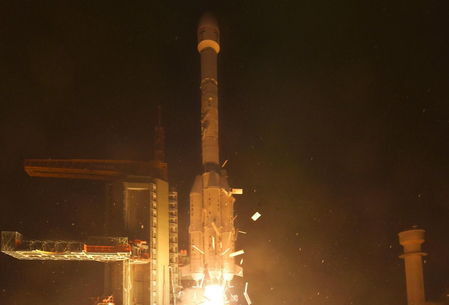
Gandhinagar, Sep 4 (IANS) Gujarat Chief Minister Bhupendra Patel and Deputy Chief Minister Harsh Sanghavi on Friday congratulated the Indian Space Research Organisation (ISRO), following the successful launch of the GSLV-F17 carrying the EOS-05 Earth observation satellite and described the mission as a “significant achievement” for India’s space programme.
The GSLV-F17 lifted off from the Second Launch Pad at the Satish Dhawan Space Centre in Sriharikota at 2:55 a.m. on Friday and successfully placed EOS-05 into a sub-geosynchronous transfer orbit.
ISRO said the mission marks the first time India has placed an imaging Earth observation satellite in a geosynchronous orbit.
The 51.7-metre-tall GSLV-F17, with a lift-off mass of about 420.5 tonnes, is the 19th flight of India’s Geosynchronous Satellite Launch Vehicle. EOS-05, weighing about 2,367kg, is designed to provide Earth observation capabilities from geosynchronous orbit.
The satellite was separated from the launch vehicle about 18 minutes after lift-off and entered the intended sub-GTO, from where it will undergo orbit-raising manoeuvres towards its operational orbit.
Reacting to the mission, Patel said on social media platform X, “Another stellar feat by our brilliant scientists! Heartiest congratulations to Team ISRO on the historic success.”
“Successful launch of GSLVF17 placing EOS05 into orbit highlights India’s rapidly growing technological prowess, under the dynamic leadership of Prime Minister Narendra Modi. Kudos to the entire team!” he added.
Sanghavi also congratulated ISRO, saying the mission represented “another giant leap for India in space”.
“The successful launch of GSLV-F17 carrying EOS-05 is yet another testament to the remarkable capabilities, precision and innovation of ISRO,” Sanghavi said.
He added that India was building a “world-class space ecosystem” through ambitious missions and stronger industry partnerships, driven by science and talent. “The sky is not the limit anymore. India is reaching beyond it,” Sanghavi said.
EOS-05 is intended to strengthen India’s Earth-observation capabilities. Its placement in geosynchronous orbit will allow it to maintain prolonged observation of the same broad region, providing data that can support applications including environmental monitoring, weather-related observation and disaster management.
Unlike satellites in lower Earth orbits that periodically pass over a location, a geosynchronous platform can provide more persistent coverage.
The successful mission also represents an important return to flight for the GSLV after the failure of the GSLV-F10 mission carrying EOS-03 in August 2021, when the cryogenic upper stage did not perform as intended and the satellite was not placed in orbit.
The latest mission therefore showcase the successful deployment of the redesigned Earth-observation spacecraft on the GSLV platform.
– IANS
mys/mr