


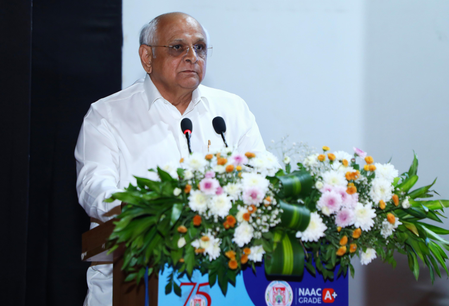
Gandhinagar, Sep 12 (IANS) Climate change, rising sea levels, coastal erosion, marine pollution and plastic waste have emerged as major global concerns, Gujarat Chief Minister Bhupendra Patel said on Saturday, stressing that economic development along the coastline must go hand in hand with environmental protection and conservation of marine biodiversity.
Patel was speaking at the valedictory ceremony of the national conference on ‘Coastal Ecology, Security and Sustainability’ held at Gujarat University in Ahmedabad.
He said that development should ensure that progress goes hand in hand with conservation of nature, industry with environmental protection and employment with the protection of marine biodiversity.
“Gujarat’s coastline is not just a geographical boundary; it is a pathway to development, a gateway to maritime trade, a symbol of cultural heritage, and a source of livelihood for lakhs of people,” Patel added.
He said that Gujarat had a long maritime tradition, noting that traders from the state had connected with the wider world through the ancient port of Lothal thousands of years ago.
“Today, ports such as Mundra and Kandla have placed Gujarat on the global trade map,” he added.
Patel said that Prime Minister Narendra Modi had recognised the potential of the coastline and envisioned it as a gateway for the development of ports, trade, industry, energy, fisheries, tourism and the environment.
He added that the approach was reflected in the country’s Blue Economy policy and the Prime Minister Narendra Modi’s vision of ‘Saptadhara’.
The Chief Minister highlighted the ecological role of mangroves, saying they act as natural protective barriers for coastal villages, support fishermen’s livelihoods and provide habitats for several aquatic species.
“During cyclones and storms, mangroves serve as a natural shield for coastal areas,” he said.
While stressing the importance of government efforts for mangrove conservation and plantation, Patel said protecting nature could not be the responsibility of the government alone and that conservation of coastal ecology was a shared responsibility of the government and society.
He also described traditional marine fishing communities, or Sagar Khedus, as “guardians of the sea” and said their livelihoods and safety were being strengthened through the ‘Sagarkhedu Sarvangi Vikas Yojana’, modern boats, diesel subsidies, safety equipment and satellite-based navigation facilities.
“Technology could play an increasingly important role in maritime security, with satellite monitoring, artificial intelligence, remote sensing, drones and smart boats helping to monitor and secure the sea,” he said.
He added that Gujarat’s coordination of technology, administration and human sensitivity had helped achieve zero casualties during cyclones, showcasing that while disasters could not be prevented, loss of life could be minimised through preparedness.
He said that Gujarat could develop a new model of growth through green ports, sustainable shipping, coastal connectivity, sustainable fisheries and responsible coastal tourism.
“The economy and environment are not in conflict but can grow together,” he added.
Patel said the ideas emerging from the conference should provide new direction to government policies rather than remaining limited to discussions and paper presentations.
During the programme, Chief Minister Patel launched a digital platform for Gujarat University alumni and inaugurated the university’s historical digital repository.
–IANS
mys/khz