


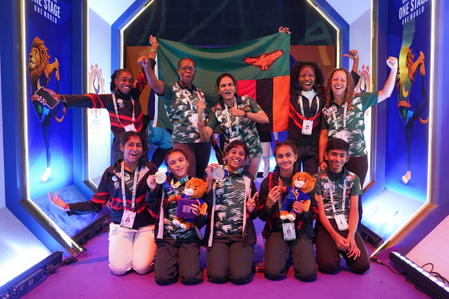
Ahmedabad, June 9 (IANS) Zambia’s remarkable journey from practising yoga on stitched-together sacks to winning medals at the inaugural World Yogasana Championship reflects the growing influence of Indian-origin communities in spreading yogasana across Africa.
When Chitula Albert first introduced yoga in his school in Zambia’s Copperbelt region, he did not have a single yoga mat. Instead, the vice-principal stitched together old sacks so that a handful of interested children could practice. Most people around him viewed yoga with suspicion.
Because of its roots in India, many associated it with religion rather than physical fitness, making it difficult for Albert to convince parents and students alike. Yet he persisted.
Albert’s own introduction to yoga dates back to the late 1980s, when he was a primary school student. An Indian resident living in the area taught him a few basic yoga practices. The lessons stayed with him for decades.
Years later, after becoming a teacher and eventually a vice principal, Albert saw yoga as an opportunity to improve children’s health and discipline. He began conducting small sessions in school, integrating yoga into physical education activities.
The early numbers were modest. Just five students turned up. But word gradually spread. Children enjoyed the practice, and Albert started using social media to reach a wider audience. He regularly live-streamed sessions, allowing youngsters from different parts of Zambia to watch and participate.
What started as a small school initiative soon began attracting attention beyond the Copperbelt.
A significant boost came in 2020 when an Indian-origin woman sponsored yoga mats for schoolchildren. For a programme that had relied on stitched sacks and improvised equipment, the support was transformative.
Over the next few years, yoga steadily gained ground across Zambia. More schools joined in, participation increased and efforts began to formalise the sport.
Indian-origin residents in the country became key supporters of the movement. Their assistance helped organisers build a structure that could sustain the sport’s growth.
The breakthrough arrived when government authorities started taking notice. The country’s yoga body secured official recognition from sports authorities in 2022, and from 2024 onwards, Zambia began conducting regular national Yogasana championships.
To further assess the sport’s development, officials from the ministry attended the 2025 national championships. Their visit reinforced confidence in the federation’s work and helped strengthen institutional support.
The results of those efforts were visible at the inaugural World Yogasana Championship in Ahmedabad’s EKA Arena.
Albert travelled with an 18-member Zambian contingent, bringing together athletes from different regions and communities, including participants from the Tonga tribe in southern Zambia. Six members of the team were sponsored by Indian-origin families living in the country.
Their performances reflected the rapid progress made in a short period. On Sunday, Zambia collected six medals, with young Niya Vijayvarjiya emerging as one of the stars of the contingent by winning three silver medals.
The championship also underlined yoga’s growing influence across other African nations inspired by Indians living there. Athletes from Rwanda, Niger, Chad, Sierra Leone, Lesotho, Uganda and Tanzania were among those participating. Many are studying in Indian universities and were introduced to yogasana during their time in India.
For some, the event was their first international exposure. For others, it was an opportunity to learn from practitioners from around the world and take those experiences back home.
Mahamadou Sanoussi Issia, Niger’s lone representative, said yoga is slowly finding a place in his country as well. According to him, celebrations linked to Yoga Day begin back home on June 7 before culminating in competitions around the International Day of Yoga on June 21.
For Albert, the scene unfolding at the World Championship was almost unimaginable a few years ago, as he constantly juggled between managing the Zambian contingent at the competition and monitoring his pupils back home on social media.
–IANS
sds/