


New Delhi, Sep 26 (IANS) There was a time when Shafali Verma was out of the Indian women’s cricket team, watching from the sidelines and going through what she describes as one of the saddest moments cricket has given her.
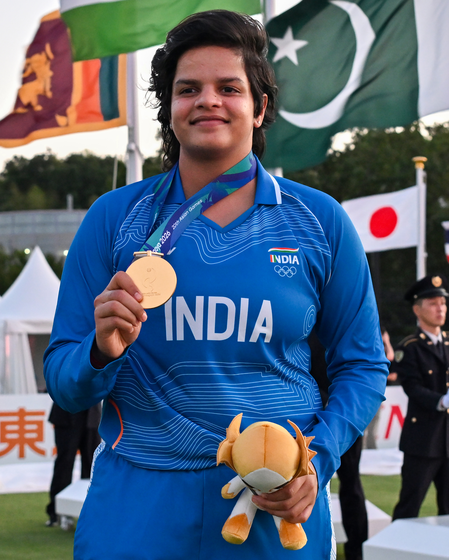
A year later, she was back in the national side, helping India win their maiden Women’s ODI World Cup and then topping the run charts at the 2026 Asian Games women’s cricket competition, in which India successfully defended their gold medal.
The shift for Shafali was not just about runs or trophies. It was about accepting the setback, working on herself, and getting back the belief to come back stronger.
“When I was dropped from the team, it was the saddest moment that cricket has given me in my entire life. But I think that moment was very hard for me. I only know how hard I worked when I was out of the team,” Shafali told IANS in a media roundtable facilitated by JSW Sports.
“And first of all, the best thing I did was that I accepted everything. Yes, I’m not in the team, but I have to work hard. And I have to utilise this time very well.”
“And I have to show that I’m the best. I’m the best for my country. I’m the best for my team.”
Her return to the national team came when Pratika Rawal’s injury opened the door for Shafali to be drafted in as a replacement for the 2025 ODI World Cup.
What followed would become one of the defining periods of her career, and a difficult one too. Shafali scored 87 and took two wickets in the final against South Africa as India clinched their maiden Women’s ODI World Cup trophy.
But the work that made that moment possible had started much earlier. “So, I worked very hard for that. I worked on my mental health, I worked on my skills, and I worked on my fitness. So I’m glad that at that time, I decided everything and worked on myself,” she said. “And I didn’t let myself face any incidents or talk about it. And thanks to my family as well. They supported me a lot at that time.”
“And I think in the end, family is everything for us. And the way they backed me at that time, so just thanks to them. And then the happy tears came when we won the ODI World Cup.”
For Shafali, those tears represented more than the joy of winning a World Cup.
“And now, I think, whatever trophies and medals we win, so in front of my eyes, all my hard work and all my sweat comes in front of me that, yeah, I’m doing great things for my team. I’m doing the hard work for my team. And showing all the sweat and giving everything to my country,” she said. “So I think there is no moment of more praise than that as a player.”
The welcome she received on returning to the Indian dressing room was another important part of the comeback.
“I think the support of my teammates, the support of the coach, I think it’s the best feeling, and I think when I participated in an ODI in 2025, I was very happy and motivated, and I think everyone was very excited to see me in the team,” Shafali said. “The way they welcomed me at that time, I think that’s the happiest thing as a player.”
“What you want from everyone, they did that only. Thanks to them. The way they are managing the team, the way they are managing everything.”
“I think everything is happening because of them. Thanks to them.”
Shafali also spoke about the environment within the team and the importance of ensuring players feel comfortable enough to express themselves.
“We try to keep them in a good space and push them up so that they perform well and don’t feel scared or hesitate to say anything,” she said. “Because of that, everything is reflecting, and everything is going our way.”
The Asian Games was another opportunity for Shafali to show how far she had come, just as the World Cup had been the highlight of her comeback.
She was the top scorer of the tournament, finishing with 188 runs at an average of 188 and a strike rate in excess of 200; her performances consisted of a 40-run score against Japan in the quarterfinal, a century made off 49 balls against Bangladesh in the semifinal – this being the first century in the history of women’s cricket at the Asian Games and also her first T20I hundred – and 48 runs in the final match played against Sri Lanka.
India beat Japan by eight wickets, Bangladesh by 114 runs and Sri Lanka by 147 runs to retain the gold medal.
Yet Shafali sees the Asian Games success as part of something bigger than her own performances.
“Well, of course, I think as a player and as a team, we’ll just try to bring more and more trophies to grow Indian women’s cricket,” she said. “And I know when we won the ODI trophy, we lifted it. After that, I’m pretty sure that Indian women’s cricket has grown a lot. And there were a lot of setbacks. And I think we’ll try not to have those setbacks and make our nation proud.”
Her experience in Japan also left an impression beyond the cricket field. “And talking about the Asian Games, when we went to Japan, we didn’t even think how good the facilities would be. But the way Japan associated us, the way they gave us the ground stuff, so it’s really praise for them.”
“And just seeing the seriousness in Indian women’s cricket, so that’s a very happy thing for us. And it’s more of a motivating thing to do the good things for our nation, to do the good things for our team. So I think it’s just a praise moment and a very motivating thing.”
That seriousness is reflected in a career that had already produced several landmarks before her latest run of success.
Shafali became the youngest player ever to score 1,000 runs in T20Is and climbed to the top spot in the women’s T20I batting rankings. She led India to victory at the first Women’s Under-19 T20 World Cup in 2023. The following year, she showed yet another aspect of her abilities by scoring an amazing 205 against South Africa in a Test match.
Now, having gone through the letdown of being left out, the pleasure of winning the World Cup and the excitement of securing a gold medal at the Asian Games, Shafali is looking past his individual achievements.
–IANS
hs/bsk/