


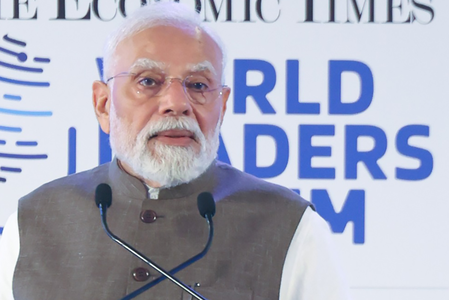
New Delhi, Aug 22 (IANS) Prime Minister Narendra Modi’s repeated emphasis on punctuality goes beyond being advice on the importance of abiding by a schedule to that of reshaping a national habit where generations have been used to holding “stylishly late” and “chalta hai” (anything goes) as normal.
In the severe seventies, proponents of the Emergency at that time would celebrate government offices and trains working strictly as per schedule as a cover for the ills the period bestowed. In India, the idea of punctuality has long been more aspiration than reality. For decades, trains ran hours late, buses broke down randomly because of delayed maintenance, and government offices took “late” as normal. Citizens accordingly adjusted themselves, arriving at railway stations prepared for long waits, or standing in long queues to submit applications with the resigned knowledge that resolution might take years.
In fact, there evolved a system of “reserving” a place in a queue by placing a brick or some other object that would usually be respected by others. Though not always, as several verbal and physical tiffs would sometimes follow. This culture of delay seeped into everyday life: events rarely began at the announced hour, meetings started long after the scheduled time, and even school assemblies often ran late.
The abbreviation of IST for Indian Standard Time became a joke, rephrased as “Indian Stretchout Time”. Against this backdrop, when PM Modi praised the Delhi Metro and Namo Bharat Rapid Rail for achieving 99.9 per cent punctuality, he framed it as governance itself arriving on time. As someone having lived those days, in his speeches and statements – from Mann Ki Baat to Friday’s ET World Leaders Conference – the Prime Minister has consistently linked punctuality to discipline, respect, and efficiency. The Prime Minister’s critique of the “chalta hai” attitude is central to this narrative.
For generations, complacency allowed delays to be normalised, like the late arrival of a train, the babu to office, or a guest at an event; all shrugged off with the phrase. Now, by urging citizens to replace “chalta hai” with “badal sakta hai” (things can change), he positions punctuality as the antidote to cultural inertia. In a country striving for global competitiveness, the tolerance of delay becomes a barrier to growth.
PM Modi’s insistence on punctuality is therefore not an abstract moral lesson but a pragmatic call to action. Initiatives like Mission Raftaar aimed to double train speeds, while investments in Metro systems created urban networks where Delhi Metro’s punctuality record stands out. These serve as proof that India can shed its reputation for delay.
Beyond transport, punctuality has been recently embedded into governance through digital reforms. The PRAGATI (Pro-Active Governance and Timely Implementation) initiative is for fast-tracking projects, schemes, and grievance redressal through direct, real-time review by the Prime Minister, in partnership with states and Union Ministries.
For citizens, CPGRAMS is India’s flagship digital platform for public grievance redressal, enabling them to lodge, track, and escalate complaints across all central ministries, departments, and states. These reforms matter because bureaucratic delays have long been a source of frustration. Citizens seeking basic services often faced indefinite waits, eroding trust in institutions. Thus, by enforcing timelines, governance becomes more accountable.
The significance of the Prime Minister’s punctuality rhetoric lies in its dual function. On the one hand, it addresses practical issues like the running of trains, movement of files, and attending to grievances. On the other, it serves as a metaphor for governance itself. By equating punctual trains with punctual government, PM Modi makes reforms tangible.
Citizens can measure progress in minutes saved, along with usual economic indicators. Thus, in a country where lateness was once considered “normal”, the insistence on punctuality is both a critique and promise, exhorting all citizens that India can – and must – arrive on time, for change and for progress.
–IANS
jb/uk