


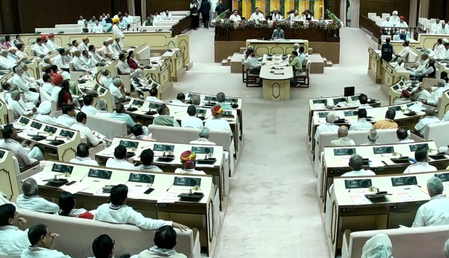
Jaipur, July 15 (IANS) As the Rajasthan Legislative Assembly celebrates 75 years of democratic journey, one number captures a significant transformation in its functioning — the steady decline in the number of sittings. From more than 300 sittings in the Assembly’s early tenures to just 84 in the ongoing 16th Assembly, the shrinking legislative calendar has raised questions about the time available for debate, public scrutiny, and democratic engagement.
The first two Assemblies reflected a strong culture of legislative deliberation. The first Assembly (1952-1957) met for 303 sittings, while the second recorded 305 (1957-1962) sittings. During that period, the Assembly functioned as an active forum where elected representatives spent considerable time discussing policies, raising public concerns, and examining decisions of the government.
Over the decades, however, the number of sittings gradually declined. The third Assembly tenure recorded 268 sittings, followed by 242 in the fourth and 200 in the fifth. The sixth Assembly witnessed a sharp fall, with only 115 sittings. Although the seventh and eighth Assemblies saw some recovery, with 168 and 180 sittings respectively, the overall trend continued downward. The ninth Assembly recorded one of the lowest figures at 95 sittings. Subsequent Assemblies held 141 sittings in the 10th Assembly, 143 in the 11th, 140 in the 12th, 119 in the 13th, 139 in the 14th, and 147 in the 15th Assembly. The ongoing 16th Assembly has held only 84 sittings so far.
The decline is not merely a matter of numbers; it reflects the shrinking space available for legislative conversations. Every sitting provides legislators with an opportunity to question the government, debate policies, highlight constituency issues, and contribute to lawmaking. Fewer sittings naturally reduce the time available for detailed discussions on matters affecting citizens, said officials.
The issue has also drawn attention from senior political leaders. Lok Sabha Speaker Om Birla on Wednesday emphasised the importance of active participation and meaningful discussions in legislative bodies.
“There should be more discussions, more debates and greater participation in the proceedings,” he said, underlining that the strength of democracy depends on the quality of debate inside the House.
The Leader of Opposition in the Rajasthan Legislative Assembly also called for greater participation of legislators and more substantive debates, stressing the need for the Assembly to function as a stronger platform for public issues and democratic accountability.
Jully said the decline in the number of sittings and working hours of legislative assemblies requires serious introspection. “Our second Vidhan Sabha had the highest number of sittings, with 305 meetings, and it worked for more than 1,600 hours. In the 15th Vidhan Sabha, this has been reduced by nearly half. We need to think about this,” he said. He said the strength of democracy lies in the functioning of the Vidhan Sabha and the active participation of elected representatives.
“The strength of democracy is the Vidhan Sabha. Bills have been passed amid disruptions; MLAs are not getting enough opportunities to speak, and members sometimes remain silent during debates. Gradually, the role of legislators in the legislative process is being weakened,” Jully said.
Clarifying that the issue was not limited to any particular government, he said, “I am not talking about any one government because under every government, the role and functioning of the legislature has reduced. We need to increase the number of sittings and strengthen legislative participation.”
Recalling the contribution of state legislatures, Jully said several important laws and reforms that gained national significance had their roots in legislative discussions in Rajasthan. He referred to measures related to the Right to Information, abolition of sati pratha, Panchayati Raj reforms, street vendors’ rights and other initiatives. He stressed that stronger debates, greater participation and a more active role for legislators are essential for strengthening democracy.
The message from both sides of the political spectrum reflects a common concern: that the Assembly must remain more than just a place where laws are passed; it must continue to serve as the primary forum where the voices of Rajasthan’s people are heard, examined, and debated.
As the House enters its Platinum Jubilee year, the challenge before Rajasthan’s legislators is not only to celebrate a proud legacy of democratic traditions but also to revive the spirit of discussion, participation, and accountability that defined its early decades, said officials.
–IANS
arc/dpb