


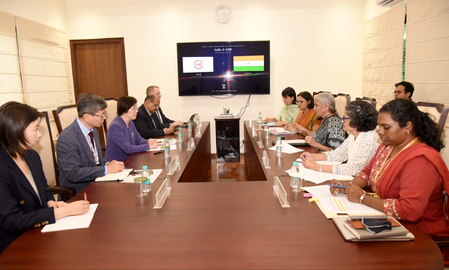
New Delhi, Sep 12 (IANS) Finance Minister Nirmala Sitharaman on Saturday met the Asian Infrastructure Investment Bank (AIIB) President Zou Jiayi and discussed opportunities to further deepen the India–AIIB partnership.
They also discussed ways to support India’s infrastructure and transport connectivity priorities, enhance local-currency financing, increase private-sector participation and global presence of AIIB, according to Finance Ministry.
Jiayi arrived in New Delhi to attend the 18th ‘BRICS Summit 2026’. Extending a warm welcome to Jiayi, the Ministry of External Affairs (MEA) took to X and posted, “The visit will strengthen partnerships to advance sustainable development and expand opportunities for emerging economies.”
Sitharaman earlier met Denis Manturov, First Deputy Prime Minister of the Russian Federation.
Both sides held discussions on ways to further strengthen and deepen economic cooperation between the two countries.
It was agreed to advance negotiations on a Bilateral Investment Treaty (BIT), with a view to establishing a mutually beneficial framework for enhancing investment flows and economic engagement, according to an official statement.
They also deliberated on opportunities to further strengthen cooperation in the financial services sector.
Meanwhile, PM Modi on Saturday announced the unanimous adoption of the New Delhi Declaration 2026 at the 18th BRICS Summit held in the national capital.
In his closing remarks at the BRICS Summit’s session on ‘Inclusive Global Governance and Strengthening Multilateralism’, PM Modi said, “The New Delhi Declaration adopted today gives clear direction to our shared resolve. Now it is our responsibility to convert these resolutions into concrete results.”
PM Modi said that the discussions between the BRICS leaders included perspectives on key regional and global issues and priorities to further strengthen BRICS cooperation.
He described the discussions between BRICS leaders “meaningful and constructive.” He said that today’s discussions showcased that the changing world order cannot be managed by old institutions.
–IANS
na/