


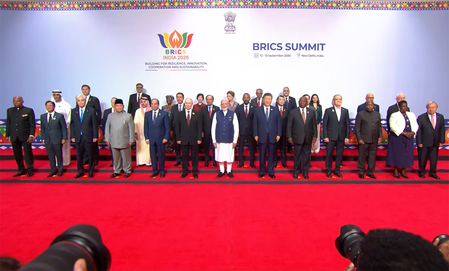
New Delhi, Sep 13 (IANS) Some moments in a nation’s journey are recorded in history forever. The adoption of the New Delhi Declaration at the BRICS 2026 Summit was certainly one such moment, not because the declaration itself was unexpected, but because many had doubts about whether the member countries would be able to agree on anything at all.
With conflicts raging in West Asia, the Russia-Ukraine war continuing into its fourth year, and the United States repeatedly changing tariff rules and taking an increasingly aggressive approach towards several countries, the global situation could hardly have been more complicated. And when some BRICS members themselves have big differences, expectations of consensus are naturally low.
Almost the whole world is being affected by these crises. There are growing concerns about peace, stability, trade, businesses and the future of global supply chains. Amid all this uncertainty, the BRICS Summit in New Delhi has at least tried to point towards a different direction.
Prime Minister Narendra Modi-led BRICS 2026 presented a platform that put cooperation ahead of confrontation and spoke about mutual growth, respect and the need to reinforce multilateralism.
The Summit has also shown that BRICS is no longer merely a grouping of emerging economies sitting together for an annual meeting. But it is becoming an increasingly important platform through which the Global South is trying to make its voice heard.
US President Donald Trump had once dismissed BRICS as “dead” and has repeatedly threatened higher tariffs against its members. The New Delhi Summit, however, offered a different picture. Whatever the differences within the grouping, the countries managed to arrive at a common declaration and reaffirm the importance of multilateralism, multipolarity and respect for international law.
This assumes greater significance at a time when the world has witnessed violations of international norms, unilateral actions and growing questions over the effectiveness of institutions such as the United Nations and the UN Security Council.
The present global situation could not perhaps have been better described by Prime Minister Modi in his opening address at the Summit. Referring to the existing global decision-making structure, he said it looked like a “pyramid of privilege”.
It was a sharp criticism of a global order in which decisions affecting developing and least-developed countries are often taken without giving them an adequate voice. Calling for a reset of global governance, PM Modi said, “The Global South is in the front row of global crises, but in the back row of decision-making.”
He called for replacing the existing “pyramid of privilege” with a “platform of partnership” where every country has a voice, every member has a stake, and human development remains at the centre of global efforts.
With this Summit, the Prime Minister has set an example for the world, presenting a platform where voices are heard. He said confidence of Global South nations in BRICS has increased because their voices are heard within the grouping, stressing that the strength of BRICS lies in its diversity and cooperation.
The messages were clear and sharp. But perhaps the real test of diplomacy is not what leaders say from the podium. It is what happens when countries with differences actually sit across the table.
And that is where an unexpected diplomatic moment in New Delhi became significant.
On September 11, at Bharat Mandapam, UAE Crown Prince Sheikh Khaled bin Mohamed bin Zayed Al Nahyan met Iranian President Masoud Pezeshkian along with their respective delegations. The two leaders shook hands warmly.
The significance of this meeting cannot be ignored. It came at a time when the West Asia conflict has created deep divisions and when even diplomatic efforts to bring the opposing sides closer face difficulties.
The important point is not that all differences suddenly disappeared. They did not. Nor does one meeting mean that a complicated conflict has been resolved.
But two countries with sharply different positions were able to sit together, talk and engage, and that itself matters.
It also demonstrates why a platform like BRICS can have relevance even when its members do not agree on everything. Diplomacy does not always mean making differences disappear. Sometimes it simply means creating enough space for countries to talk despite those differences.
India has consistently maintained that dialogue and diplomacy are the way forward in resolving conflicts. During the Summit, Prime Minister Modi reiterated that position and said India stood ready to assist in peace efforts.
New Delhi’s approach has therefore been to keep the doors of dialogue open rather than allow differences to paralyse the grouping.
The Iran-UAE interaction may not by itself change the course of the West Asia conflict, but it certainly showed what diplomacy can achieve when countries are given a platform to engage. This is perhaps the bigger message of the New Delhi Summit.
The Summit also showed another aspect of BRICS diplomacy. Russian President Vladimir Putin, speaking from the Summit venue, sent a message to Europe that Russia did not pose a threat to European countries. At the same time, on September 11, he warned that any deployment of European troops to Ukraine would amount to “a war against Russia”.
It was also an opportunity for Putin to use the BRICS platform to make his stance on the Ukraine conflict clear.
BRICS may have its contradictions. Its members may disagree on wars, geopolitics and global priorities. But the fact that they still managed to sit together and produce a consensus at a time when the world is increasingly divided is itself an achievement.
The BRICS Summit has therefore been more than just another diplomatic gathering. It has shown the extent of India’s diplomatic space and the importance of keeping communication alive even in difficult times.
And perhaps, for a change, it is also a moment to quieten those who are always ready to point fingers and play the role of the perpetual ‘phuphaji’ — the one who finds fault with the arrangements even when the entire family has finally managed to sit together.
(Deepika Bhan can be contacted at deepika.b@ians.in)
–IANS
dpb/sd/