


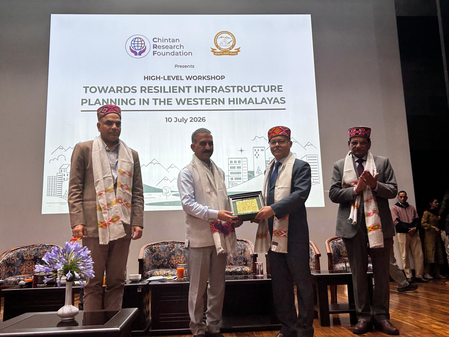
Shimla, July 11 (IANS) Himachal Pradesh has made remarkable progress in education, healthcare and other socio-economic indicators despite its challenging terrain, Dr VK Paul, former member of NITI Aayog, has said.
However, unless infrastructure is systematically climate-proofed against the growing risks posed by climate-induced disasters, these hard-earned developmental gains could be significantly undermined, setting the state’s development trajectory back, he said during a workshop on ‘Towards Resilient Infrastructure Planning in the Western Himalayas’ here, organised by Chintan Research Foundation (CRF), in collaboration with the Dr Manmohan Singh HP Institute of Public Administration (MSHIPA).
In his address, Chief Minister Sukhvinder Singh Sukhu revisited the 2025 disasters in Mandi, and called for the synchronised work among line departments to better plan and design our future infrastructure while keeping those memories in mind.
He also assured that the Himachal government is dedicated for inclusive development in the hill state and climate proofed infrastructure is very pertinent pillar to ensure inclusive development.
The workshop commenced with a welcome address by Rupali Thakur, Director, MSHIPA, followed by the opening remarks by Dr Debajit Palit, Centre Head, Centre for Climate Change and Energy Transition, CRF.
Dr Palit highlighted that climate change in the Himalayas is no longer merely an environmental concern but has equally become a question of development, public investment and long-term economic resilience.
Prabodh Saxena, former Chief Secretary-cum-Chairman, Himachal Pradesh State Electricity Board, traced how the nature of disasters has evolved over time.
According to a statement, he observed that the interaction between climate change and the region’s inherent geological fragility has amplified the scale of socio-economic and infrastructure losses.
Emphasising the imperative of climate-proofing developmental pathways, he remarked, “If we do not prepare today, we are doomed to perish tomorrow.”
Representing the Ministry of Environment, Forest and Climate Change, RK Singh emphasised proper infrastructure planning to avoid future disasters.
A discussion paper, titled ‘Rethinking Infrastructure Development in the Western Himalayas towards Climate Resilient Infrastructure’, authored by CRF researcher Dr Pooja Sehbag, was also unveiled at the event.
The workshop also saw three technical sessions panellists argued for the periodic risk assessment and aligning the developmental approach to regional subjectivities and stressed on the need for context specific planning.
They also discussed how planning frameworks, engineering practices and institutional coordination must evolve to respond to the emerging realities of climate change in mountain regions.
The panellists also deliberated on the governance question, how climate resilience can be included in the on-ground actions. The panel unanimously agreed for the active inclusion of community stakeholders and efficient interactive coordination among line departments for enduring climate proofing of the Himalayan Infrastructure.
–IANS
na/