


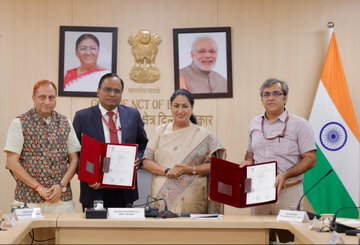
New Delhi, July 30 (IANS) Delhi Chief Minister Rekha Gupta on Thursday steered the signing of an MoU between the Municipal Corporation of Delhi and Oil India Limited for setting up Compressed Bio-Gas plants in Tughlakabad and Okhla, officials said.
The MoU is the latest among the efforts being made by the Delhi government and the Centre to reduce the mountains of waste at landfills through remediation and other techniques.
In a message on X, CM Rekha Gupta said, “Today, at the Delhi Secretariat, an MoU was signed between the Municipal Corporation of Delhi and Oil India Limited for the establishment of Compressed Bio-Gas plants with 800 TPD capacity in Tughlakabad and Okhla.”
“In these plants, bio-gas will be produced from segregated organic waste. This will reduce the mountains of waste, increase the production of clean energy, and further strengthen our resolve for a ‘Clean Delhi’,” she said.
On this occasion, Mayor of Municipal Corporation of Delhi Pravesh Wahi, along with officials, was present, she said.
Earlier, Minister of State (MoS) for Environment, Forest and Climate Change Kirti Vardhan Singh said that out of the seven legacy waste dumpsites identified in the Delhi-National Capital Region (NCR), remediation at four dumpsites has been completed.
In reply to a question in Parliament, the MoS added that the seven legacy waste dumpsites identified for remediation in the Delhi-NCR include three in Delhi and one in Gurugram, Noida, Greater Noida and Ghaziabad.
Kirti Vardhan Singh said that for the abatement of pollution from the municipal solid waste and legacy waste, Central Pollution Control Board (CPCB) issued a direction on January 27, 2021, under Section 5 of the Environment (Protection) Act, 1986, mandating all State Pollution Control Boards (SPCBs)/Pollution Control Committees (PCCs) to take action for biomining and bio remediation of legacy waste dumpsites.
He said the Commission for Air Quality Management in NCR and Adjoining Areas (CAQM), on June 3, 2025, directed the agencies in the NCR to take appropriate actions for management of legacy waste at sanitary landfill sites and dumpsites.
The CAQM had said that the measures were important to tackle air pollution through open burning of municipal solid waste (MSW)/open biomass generating Particulate Matter (PM10 and PM2.5) and other harmful gaseous pollutants (NO2, SO2, CO, Dioxins, Furans, etc.), in the region.
The MoS said that the Central government has notified the Solid Waste Management Rules (SWM) Rules, 2026, superseding the earlier SWM Rules, 2016, with provisions for proper and effective management of municipal solid waste (MSW), including sanitary landfills. The Rules have come into force with effect from April 1, 2026.
–IANS
rch/dan