


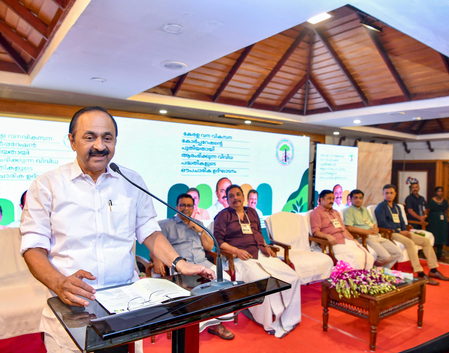
Thiruvananthapuram, Oct 2 (IANS) “Change the style of functioning” may well be one of the oldest phrases in the political lexicon of the Congress in Kerala, and Chief Minister V.D. Satheesan is the latest party leader to hear it — four months after he took over his post.
UDF convenor and Congress MP Adoor Prakash has accused Satheesan of taking important decisions without adequate consultation with the party and coalition partners.
He has said he often learns about major decisions through the media and plans to take up his grievances with the Congress high command.
SNDP Yogam General Secretary Vellappally Natesan on Friday has now used almost the same language, saying Satheesan should “change his style of functioning”.
There is a certain sense of deja vu about the ‘complaint’.
The story goes back several decades.
During the factional battles that eventually brought down K. Karunakaran’s government in 1995, the demand for a change in the Chief Minister’s style of functioning was among the issues raised by his opponents.
A.K. Antony subsequently became Chief Minister. Later, Antony himself faced intense factional opposition, with political rivals complaining that the internal battles were constraining his functioning.
Then came Oommen Chandy, whose political style was almost the opposite, as he built his reputation around accessibility and constant interaction with people.
Yet even during his tenure, criticism over consultation and the manner in which decisions were taken repeatedly surfaced.
The irony is hard to miss.
Every generation of Congress leaders appears to inherit not only the party organisation, its factions and its old arguments, but also the familiar complaint about the way power is exercised.
Satheesan now finds himself at the receiving end.
The immediate dispute concerns appointments, including IUML leader M.K. Muneer as Chairman of the Administrative Reforms Commission and Forward Bloc leader G. Devarajan as the government’s Special Representative in New Delhi. Prakash has stressed that his objection is not to the individuals but to the manner in which the decisions were taken.
The IUML, the second-largest UDF constituent, has sought to cool the controversy.
P.K. Kunhalikutty has said there are no major ‘Himalayan’ problems in the UDF and that several matters were settled through bilateral discussions.
Panakkad Sadiq Ali Shihab Thangal has also said differences can be discussed and resolved.
For Congress, therefore, the latest dispute carries an old question.
Leaders change. Governments change. Chief Ministers change. But the demand to ‘change the style of functioning’ seems to have acquired a life of its own.
–IANS
sg/vd