


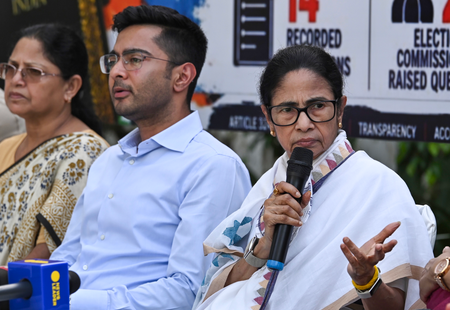
New Delhi, Oct 5 (IANS) Trinamool Congress founder Mamata Banerjee recent announcement of setting a “deadline” of 15 days for MPs and MLAs who left the party to come back may be seen as a bid to reverse the massive erosion that hit her organisation after a resounding loss in the West Bengal Assembly election this year.
Asked a day after the INDIA bloc meeting in Delhi last week, Mamata Banerjee’s nephew and party General Secretary Abhishek Banerjee had put the decision of taking back the rebels into her hands.
Sitting beside him, the party supremo’s brief answer had appeared warm enough for a possible reconciliation.
Mamata Banerjee’s direct offer has thus reopened debates on whether the outreach portrays her desperation or being “overly forgiving” towards even those who defy her.
Seen in the context of the younger Banerjee’s July statement, where he had dared the deserters to return, offering to resign “within an hour” in the face of their complaints about his functioning, the former Chief Minister’s “offer” now portrays more desperation than anything else.
Amidst this, there is a viewpoint being publicly stated about the party supremo having chosen the “wrong people” as faces representing the earlier Trinamool Congress.
This has gained ground following the mass desertion, with one more rebel MP actor Rukmini (Koel) Mallick having filed nomination as Bharatiya Janata Party (BJP) candidate for the upcoming Rajya Sabha by-poll for a seat which she herself had vacated this July.
The issue was raised by journalist-turned-politician Kunal Ghosh, known as a close confidante of Mamata Banerjee and an MLA, who has emerged as one of the party’s most recognisable spokespersons due to his aggressive media presence, sharp political attacks, and blunt statements.
Earlier a Rajya Sabha MP for Trinamool, his career was severely disrupted by the Saradha chit fund scandal. He was arrested in November 2013 in connection with the financial fraud investigation. During his imprisonment, he fell out dramatically with the party leadership, claiming he was being made a scapegoat. He publicly demanded that investigators question Mamata Banerjee and at one point described her as the “biggest beneficiary” of Saradha’s media operations, causing major embarrassment for the party.
He spent nearly three years in jail before obtaining bail in 2016.
Despite his attacks, Ghosh’s reinstatement in 2020 and appointment as a party spokesperson later was widely seen as a signal from Mamata Banerjee that former rebels could be rehabilitated if they returned to the party line.
Since then, he has regained influence as a spokesman, organiser, and eventually a key public defender of the leadership, though his no-holds-barred commentaries continue, though not aimed directly at the supremo.
His most notable intra-party feud has been with Sudip Bandyopadhyay, where ahead of the 2024 Lok Sabha election, he openly attacked the veteran MP, raised questions regarding issues allegedly linked to another financial scam associated with the Rose Valley group, and declared that he would not campaign for him if renominated.
Ghosh accused the senior politician of weakening the party organisation, driving away workers, and maintaining questionable political equations.
Bandyopadhyay has since shifted allegiance to the Nationalist Citizens Party of India (NCPI) with 19 other rebel colleagues in Lok Sabha. Interestingly, the veteran politician had earlier also fallen out with Mamata Banerjee and was subsequently reinstated.
Mamata Banerjee had reportedly expelled Bandyopadhyay from the party after the latter met then-Deputy Prime Minister Lal Krishna Advani, believing it was an attempt to secure a Cabinet berth in the Atal Bihari Vajpayee-led National Democratic Government (NDA) government.
The dispute became one of the earliest major internal crises in the Trinamool Congress. Reports from the period also describe how the friction affected their personal political relationship in Delhi, where both were staying in facing apartments at government accommodations. Then too, the estrangement did not last permanently, and in 2008, he returned to the Trinamool after a stint with his alma mater, the Congress.
After reconciliation, like Ghosh later, Bandyopadhyay once again became one of Mamata Banerjee’s closest parliamentary lieutenants, and served repeatedly as the Trinamool’s leader in the Lok Sabha.
There have been a few other similar incidents in the past. In the present scenario, considering her recent loss at the hustings and a fast-depleting organisational strength, it raises the question for a septuagenarian Mamata Banerjee who once painted West Bengal blue-and-white, replacing the red of the once-formidable communists: will she be able to revive the magic of yore against the saffron surge?
–IANS
jb/vd