


Ahmedabad, Oct 12 (IANS) India has proposed a voluntary repository of traditional and indigenous sports, exchanges among coaches and researchers, and periodic demonstrations at future BRICS sporting events to preserve sporting traditions and strengthen cooperation among member countries.
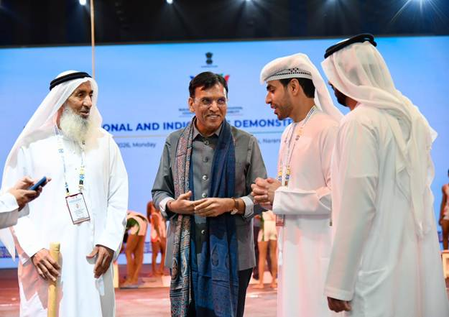
Union Sports Minister Mansukh Mandaviya made the proposals while inaugurating the BRICS Traditional and Indigenous Demonstration Games 2026 at the Veer Savarkar Sports Complex in the Naranpura area of Ahmedabad on Monday.
Gujarat Deputy Chief Minister Harsh Sanghavi was also present at the event, which brought together country delegations, athletes, practitioners, technical officials and partner institutions from 10 BRICS nations.
Mandaviya said the proposed repository could document the history, cultural significance, rules, equipment and playing requirements of traditional sports, helping preserve knowledge associated with different communities.
“BRICS Traditional and Indigenous Games provide a platform to showcase not only how a sport is played, but also the history, values and cultural context that make each tradition unique,” he said, outlining the three areas of cooperation.
The second proposal involves exchanges among practitioners, coaches, researchers, educational institutions and cultural experts across BRICS countries.
The third calls for exploring regular demonstrations of traditional and indigenous sports at future BRICS sporting events.
Addressing representatives of the participating countries, Mandaviya said India was placing sport at the centre of nation-building through investment in infrastructure and a broader approach to developing athletes.
“India is placing sport at the centre of nation-building. Under the leadership of Prime Minister Narendra Modi, India is transforming its sporting ecosystem by creating opportunities from the playground to the podium,” he said.
He said the country’s approach covered grassroots participation, talent identification, coaching, sports science, infrastructure development, athlete welfare and international exposure.
Mandaviya also said nearly 3.76 billion US dollars had been committed under the ‘Khelo India’ initiative to support this transformation.
The minister highlighted the Fit India Movement as part of efforts to make physical activity a regular part of daily life.
“The ‘Sundays on Cycle’ campaign had brought more than five million people together for cycling across over three lakh locations every Sunday. 94 editions of the campaign had been held across India,” he said.
The event featured demonstrations of traditional sporting practices from Belarus, Bolivia, Brazil, China, India, Iran, Kazakhstan, Russia, South Africa and the United Arab Emirates. Belarus and Russia showcased Gorodki, while Russia also presented Sambo. Bolivia demonstrated Lucha de Cholitas, Tinku, Rayuela, Trompo, Cachinas and Carrera de Sacos.
Brazil presented Zarabatana, an indigenous blowpipe activity, Corrida de Toras or log racing, Brazilian para-Jiu-jitsu and Capoeira. China showcased Wushu, Lion Dance and Health Qigong, while India’s demonstrations included Mallakhamb, Yogasana and Kalaripayattu.
Iran presented Zoorkhaneh, Haft Sang and Ghanieh; Kazakhstan demonstrated Asyk Atu, Togyzkumalak and Qazaq Kuresi; South Africa presented Kgati and Iintonga; and the United Arab Emirates showcased Al Tabbah.
The demonstrations were accompanied by cultural presentations and activities involving the audience. Participating teams were felicitated at the conclusion of the programme.
The event provided a platform for the participating countries to present the cultural and historical context of their traditional sports, with an emphasis on preserving community knowledge, expanding inclusive participation and strengthening people-to-people ties through sport.
–IANS
mys/dan