


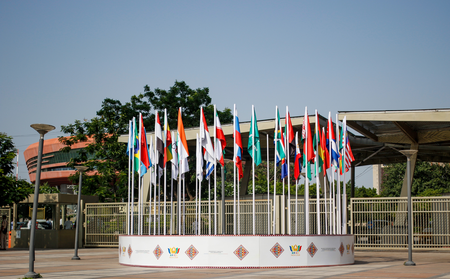
New Delhi, Sep 10 (IANS) Prime Minister Narendra Modi will welcome leaders from the expanded BRICS member-countries here as India hosts the 18th BRICS Leaders’ Summit this weekend.
India officially assumed the BRICS Chairmanship for 2026, taking over from Brazil in the beginning of this year.
Visiting heads of the 11 BRICS member-countries will meet on Saturday, while leaders from partner countries and outreach invitees will join the summit programme on Sunday.
Though New Delhi had extended an invitation, Bangladesh is yet to confirm its participation or send a government representative to the BRICS Summit with State Minister for Foreign Affairs Humaiun Kobir reportedly saying on Thursday that Prime Minister Tarique Rahman was not invited to the summit and the invitation instead extended to the current BIMSTEC Chair.
BIMSTEC is a regional organisation of seven South and Southeast Asian countries aimed at promoting economic, technical, and strategic cooperation around the Bay of Bengal.
Incidentally, few groupings have attracted as much attention perhaps as has BRICS, the coalition of Brazil, Russia, India, China, and South Africa.
The grouping was formalised at the first meeting of BRIC Foreign Ministers on the sidelines of the United Nations General Assembly (UNGA) in New York in 2006, with the inaugural BRIC Summit convened in Yekaterinburg, Russia, three years later with Brazil, India, and China joining the host.
It was agreed to expand into BRICS with the inclusion of South Africa at the BRIC Foreign Ministers’ meeting in New York in 2010.
Accordingly, South Africa attended the 3rd BRICS Summit in Sanya on the island of Hainan, China, in April 2011.
Together, the five nations represent more than 40 per cent of the world’s population and nearly a quarter of global GDP.
China’s rise as the world’s second-largest economy, India’s global influence and expanding technology sector, Russia’s energy resources, Brazil’s agricultural strength, and South Africa’s mineral wealth have given the bloc considerable weight and created a diverse economic portfolio.
Meanwhile, intra-BRICS trade has expanded steadily, with China emerging as the largest trading partner for most members. This economic clout has translated into political influence.
BRICS has become a platform for articulating the concerns of the Global South, often presenting unified positions on issues such as climate change, reforming the United Nations Security Council, and resisting unilateral sanctions.
Subsequently, the group has positioned itself as a counterbalance, embodying the broader shift toward a multipolar world where power is distributed more evenly among nations.
Egypt, Ethiopia, Iran, Saudi Arabia and UAE became full member of BRICS from January 2024 and Indonesia in January 2025.
Belarus, Bolivia, Kazakhstan, Cuba, Malaysia, Nigeria, Thailand, Uganda, Uzbekistan and Vietnam joined BRICS as Partner Countries in 2025.
The bloc also serves as a useful platform for consultation and cooperation on contemporary issues having global as well as regional significance, and issues of global political and economic governance.
The origins of BRICS can be traced back to 2001, when Jim O’Neill of Goldman Sachs identified Brazil, Russia, India, and China as emerging economies poised to dominate future growth.
From the outset, the aim of BRICS was clear: to provide a counterweight to Western-dominated institutions such as the International Monetary Fund and the World Bank.
The member states sought to amplify the voice of developing nations, championing reforms in global governance and advocating for a more equitable distribution of power.
This ambition materialised in 2014 with the establishment of the New Development Bank (NDB), headquartered in Shanghai, and the Contingent Reserve Arrangement (CRA), both designed to offer financial alternatives to the Bretton Woods system.
The NDB has already financed projects in renewable energy, transport, and urban development across the bloc.
Today, BRICS offers an alternative vision of cooperation where its members are central to global energy dynamics, with Russia and Brazil as major exporters and China and India as large consumers.
The grouping also contributes to technological innovation, combining India’s IT expertise, China’s manufacturing prowess, and Russia’s scientific research.
By pooling these strengths, BRICS has the potential to drive innovation and development across multiple sectors.
Though hurdles remain, BRICS continues to expand its influence.
Recent summits have invited other developing nations to participate in dialogues, hinting at a possible enlargement of the bloc.
This outreach underscores BRICS’s ambition to serve as the voice of the Global South, offering a platform for countries that feel marginalised in traditional Western-led forums.
–IANS
jb/khz