


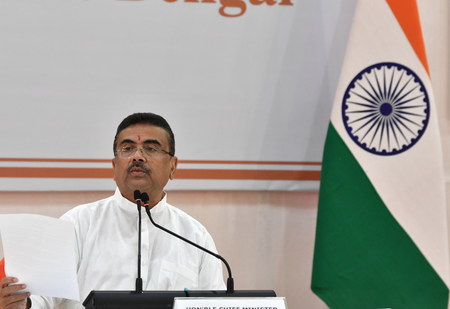
Kolkata, Aug 24 (IANS) As the new West Bengal government is gearing up to announce its new industrial policy by the middle of September this year, the proposed policy is likely to have a separate section to encourage investors to make persons from whom land is taken for setting up industries the stakeholders in those industrial units.
This proposal was included in the new industrial policy to eliminate possible complications in land procurement for setting up industries, which were witnessed during the Late Buddhadeb Bhattacharjee-led Left Front regime. Major agitations broke out in the state over land procurement for industries first over a small car project in Singur in Hooghly district and then over a chemical hub project at Nandigram in East Midnapore district during the Left Front rule.
A state government official involved in preparing the new industrial policy said as part of broader proposals to make landowners the stakeholders in the industrial units concerned, there could be two options for achieving that goal.
“The first option is to provide employment to one member of the land-owning family in the proposed industrial unit. The second option is enabling the land-owners to set up ‘indirect support’ entrepreneurship catering to the main industrial unit,” the state government official said.
According to him, generally big industrial units, both in the manufacturing and services sectors, have a scope for support industries, which may be both “direct” and “indirect” entrepreneurship.
“The ‘direct support’ entrepreneurs are those who supply technically specialised equipment for the main industries, and hence there will not be any scope for landowners to be stakeholders in this sector. However, big industries also come with a huge scope for ‘indirect support’ entrepreneurship through which the landowners can be made stakeholders,” the state government official said.
According to him, a local tailoring unit run on a cooperative basis by landowners supplying uniforms for factory workers or a canteen run similarly on a cooperative basis supplying lunch-boxes for factory staff are typical examples of such “indirect support” entrepreneurs.
The state Commerce and Industries Minister, Tapas Roy, announced earlier this month that the new industrial policy will give priority to sectors having strong demand for small support businesses, popularly and technically referred to as ancillary industries.
These sectors are textiles and garments, iron and steel, heavy electrical equipment, the automotive industry and information technology and electronics. In North Bengal, the proposed new industrial policy will also stress the Triple-T (tea, timber and tourism) sector.
–IANS
src/dpb