
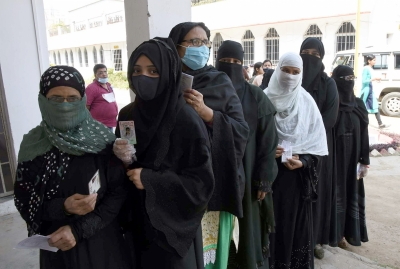
New Delhi, Oct 27 (IANS) For a long time, Opposition parties have given more than a subtle hint of their attempts at consolidating minority votes with generous doles and welfare schemes, which have largely worked for the organisation that exhibited substantial ground strength, reflecting likely winnability at the hustings.
Of late, however, voters have realised that not all governments have administered good governance and thus, the mandate has been shifting across several states, even in minority-dominated constituencies.
The latest example is the result of the recent Assembly by-poll in West Bengal’s Rejinagar, where the ruling Bharatiya Janata Party (BJP) pulled a surprise with its candidate Sakharav Sarkar winning with a convincing over 63 per cent of valid votes polled.
Muslims in Rejinagar comprise well over 70 per cent, where the controversial Babri Masjid-replica builder and founder of Aam Janata Unnayan Party (AJUP), Humayun Kabir, stepped down to retain Nowda.
He nominated his son, Golam Nabi Azad Robin, from the seat, who ended up some 75,800 votes behind the winner.
Despite the apparent shift, as Uttar Pradesh moves toward the 2027 Assembly election, a familiar contest is re-emerging among the Opposition for the larger support of the state’s Muslim electorate.
For decades, the Samajwadi Party (SP) has been the principal beneficiary of Muslim consolidation against the BJP.
But that pie is also being eyed by the Congress – a prospective SP ally – and, more aggressively, by Asaduddin Owaisi’s All India Majlis-e-Ittehadul Muslimeen (AIMIM).
The latest flashpoint is Owaisi’s invocation of “Abdul”, a symbolic reference for the ordinary Muslim voter. Addressing rallies in Uttar Pradesh, Owaisi stated that “Abdul” has long been expected to vote for political dynasties but has rarely been allowed to become a leader himself.
He accused both the SP and Congress of treating Muslims as a vote bank while denying them meaningful political representation.
Owaisi has specifically targeted SP chief Akhilesh Yadav, alleging that Muslim voters have repeatedly backed the party, which remains under-represented in terms of demographic strength.
Historically, however, the AIMIM has struggled to convert rhetoric into electoral success outside its core pockets. Yet, the political significance of the “Abdul” narrative lies in its attempt to challenge the SP’s long-standing hold over a substantial section of Uttar Pradesh’s Muslim electorate.
Owaisi appears to be seeking to carve out a space for his party in constituencies where Muslim voters can influence electoral outcomes, as he did earlier in Bihar. That may concern the SP; such statements could fan doubts among Muslim voters, especially the younger generation, who are increasingly asking whether strategic voting has delivered enough representation, jobs, educational opportunities, or political leadership.
According to Census 2011 data, Muslims constitute over 19 per cent of the state’s population with higher concentrations in western Uttar Pradesh and parts of Rohilkhand.
Districts such as Moradabad and Rampur have over 50 per cent Muslim population, while Bijnor, Saharanpur, Muzaffarnagar, and Amroha have more than 40 per cent.
Substantial Muslim populations are also present in Bareilly, Meerut, Bahraich, Balrampur, Shamli, Sambhal, and several districts of the eastern part of the state, which too can influence poll outcome.
And like elsewhere in the country, Muslim voters in Uttar Pradesh have often displayed a high degree of tactical voting, especially in the midst of a highly polarised contest.
Since the 1990s, many Muslims shifted support towards SP because it was viewed as the strongest challenger to the BJP. In some elections, the BSP also attracted substantial Muslim support, while Congress retained pockets of influence.
Thus, on occasions, and in certain parts, Muslims have not always voted uniformly for one party, frequently going strategically for whichever Opposition appeared best positioned to defeat the BJP in a given constituency. Internal divisions based on class, caste, region, sect, and local leadership have also shaped voting behaviour.
Now, Owaisi’s intervention comes at a delicate moment for Akhilesh Yadav, as he appears to be broadening his appeal beyond the traditional Muslim-Yadav alliance.
Lately, he has made visible efforts to attract Brahmins and other upper-caste voters, while also emphasising issues affecting women, welfare beneficiaries, and non-Yadav OBC groups. But Owaisi’s “Abdul” has put the Opposition on notice in the battle for Muslim votes in Uttar Pradesh.
–IANS
jb/dan