


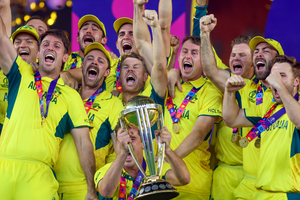
Melbourne, July 29 (IANS) Australia head coach Andrew McDonald has urged the International Cricket Council (ICC) to increase the squad limit to 17 players for the 2027 Men’s ODI World Cup, adding that the tournament’s refreshed format could turn into a war of attrition if teams are restricted to just 15 players in their respective squads.
Earlier this month, the ICC announced a new structure for the 2027 edition of the global event to be hosted by South Africa, Zimbabwe, and Namibia. Though it still features 14 teams, an additional ‘Super 7’ stage has been established before the semi-finals.
Under the new layout, the finalists will play at least 13 matches compared to 11 in the 2023 edition, with the possibility of playing up to 15 games depending on qualification routes. “One of the big things from my perspective is if it’s going to be your pinnacle event, what do your squad sizes look like? We had the dilemma of what it looked like having a 15-player squad for the last World Cup, and I think New Zealand were in the same boat where we had a couple of injuries.
“Travis Head been the most notable one, and I think Kane Williamson and a couple of others for New Zealand, where you end up with sort of 12-13 players to select from early on in your tournament, and you’re trying to carry those other players through the early rounds, and you’re not able to play potentially the way that you want to play, or structure up the way that you think you need to, and in particular in countries where you in the north or the south or the east or the west, the conditions change quite significantly,” said McDonald to SEN Radio.
Head had missed out on the first five matches of the 2023 World Cup due to a broken hand, but then returned from Australia’s league game in Dharamshala, and hit a match-winning century in the final against India in Ahmedabad. Australia’s concerns are also heightened by a grueling schedule leading into the marquee event.
They are set to play up to 21 Test matches in the preceding 14 months, including demanding five-Test tours of India and England. With key all-format fast bowlers Pat Cummins, Josh Hazlewood, and Mitchell Starc on the wrong side of 30 and having serious injury history, roster flexibility will be crucial.
“My push within it, any time you’re playing more games in the same period of time, you don’t want it to be attritional. You want the best players to be available. So, there should be a conversation around – yep, that’s great, you’ve landed at that, okay, what about the squad sizes?
“This is going to be a pinnacle event. I think there’s an argument to say, great, you’ve put more games in front of us, give us larger squads, allow us to play the way that we need to play within those conditions, and then also you’ve got the ability to carry those potential stars of the game that are under injury clouds leading in because the cricket leading into the World Cup is demanding.
“So you’re going to have some people that potentially are 50-50 at that point in time. So let’s carry the best players in there. Give us larger squads to be able to navigate through the early part, and then hopefully the pinnacle event has the best players playing, rather than being ruled out early on due to injury and the attritional nature of a World Cup,” added McDonald.
He further voiced his reservations regarding the tournament’s format, noting that Associate nations seemed to have missed out on more playing opportunities despite their recent strides in white-ball cricket. “It’s an interesting structure to a tournament. I think the Associate nations have probably been penalised a little bit in that.
“I think there was a, not a perception, but a direction potentially from the ICC that there was going to be more Associate nations at this 50-over World Cup, which we’ve seen the growth of the Associate nations within the T20 landscape, which I think has been beneficial for cricket.”
–IANS
nr/bc