
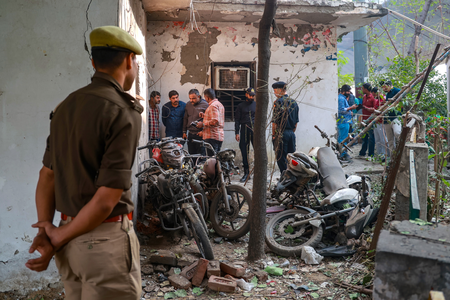
New Delhi, Nov 9 (IANS) A suspected terror link is being probed in the blast that took place at the Vasundhara police outpost in Uttar Pradesh’s Ghaziabad, with a National Investigation Agency (NIA) team visiting the spot to gather more information relating to the incident in which one food delivery executive was injured.
While the probe agencies will look into the exact nature of the blast, the interesting angle that is also being investigated is the claim made by a group calling itself the Tehreek-ul-Mujahideen (TuM).
A social media post by an organisation that called itself the TuM claimed responsibility for the incident.
An Intelligence Bureau official said that the claim comes in the wake of similar proxy organisations mushrooming.
The TuM is not an unknown organisation. A group by the same name was set up in 1990 by Yunus Khan. At the time of its formation, the TuM said that its primary objective was the liberation of Jammu and Kashmir from India.
At first, the TuM carried out grenade attacks before moving completely towards radicalisation and providing logistical support to outfits such as the Hizbul Mujahideen and Lashkar-e-Taiba.
Today the operational structure of the outfit has changed.
Recent charge sheets by the J&K’s State Investigation Agency (SIA) uncovered a prominent narcotics module that was run by the group. It is currently being managed by the Pakistan-based Mushtaq Ahmad Khan alias Khalid Bhai.
The outfit also raises funds through narcotics trade for other terror groups operating in Jammu and Kashmir, the official said.
An official said that the TuM now has several splinter factions. These factions have been investigated for orchestrating cyber crimes and smaller ground-level operations.
What the agencies are looking into now is whether the TuM that claimed responsibility for the Ghaziabad incident is a newly fabricated offshoot, the official said.
In recent months, especially after Operation Sindoor, there has been an emergence of proxy groups. Some act as proxies to bigger terror groups such as the Lashkar and the Jaish, while others just remain active on the net and issue threats that act as a smokescreen.
Pakistan has deliberately facilitated the mushrooming of such proxies to confuse investigators and try to mislead them during a probe.
Further, these proxies, which have no real ground-level presence, often mislead intelligence-related operations. Apart from trying to mislead the agencies, these proxies are also meant to provide cover for real terror groups so that they can go about their business without being tracked, the official said.
Another official said that Pakistan has created proxy groups such as The Resistance Front, the People’s Anti-Fascist Front (PAAF), the Jammu and Kashmir Ghaznavi Force (JKGF), the United Liberation Front (ULF), the Kashmir Tigers (KT), among others. Each one of these groups is a proxy of the Lashkar, the Jaish, or the Hizbul Mujahideen.
The primary focus of these groups is to flood social media with false claims so that the agencies get on their trail. This offers the bigger groups the chance to plan strikes while going unnoticed, the official said.
Another group that had kept the agencies busy was the Tehreek-e-Taliban Hindustan (TTH). This was a group created by the Shehzad Bhatti network. The idea was to call it an Indian offshoot of the Tehreek-e-Taliban Pakistan (TTP). Pakistan, which has been facing losses at the hands of the TTP, wants to create an India link by floating non-existent groups such as the TTH.
In addition to fighting the Pakistan-backed terrorists on the ground, India is also gearing up for a massive anti-proxy war. It is necessary to probe such claims and call them out before they can create more damage to the Indian agencies, an official said.
–IANS
vn/vd